Leadership, Energy, and AI: From Intent to Governed Execution

Most leadership teams are aligned on outcomes: stable margins, predictable costs, operational resilience, and sustained competitiveness. When energy performance falls short of these outcomes, the issue is rarely intent.

It is a translation.

Energy efficiency performance is shaped by thousands of operational decisions made every day across plants, utilities, and shifts such as setpoints, schedules, overrides, sequencing, and responses to deviations. Leaders review energy periodically. These decisions happen continuously.

This creates a structural gap between what leadership expects and what operations deliver.

Why energy belongs in leadership conversations

Energy is no longer just an operating cost. Variability in energy performance directly translates into variability in margins, risk exposure, and competitiveness, outcomes leaders are accountable for.

Yet most organisations still manage energy through dashboards, reports, and periodic reviews. These mechanisms explain outcomes after the fact. They do not shape behaviour while outcomes are being created.

This is not an execution failure.
It is an operating model limitation.

The real mismatch: leadership works through intent, energy through events

Leadership operates through direction: 

  • targets
  • policies
  • guardrails

Energy systems operate through events: 

  • deviations
  • anomalies
  • trade-offs
  • moment-by-moment operational decisions

When intent is reviewed periodically but decisions occur continuously, consistency breaks down. Performance becomes dependent on individuals, experience, and availability, not on a system.

Where AI changes the equation

AI’s real contribution is not better analytics.
It is governance with operational control at scale.

An effective AI layer:

  • detects deviations as they occur
  • adds context on what changed and why it matters
  • prescribes or, where appropriate, automates the next operational action
  • applies the same decision logic across plants and shifts

This ensures leadership intent does not stop at visibility, but translates into action at the point decisions are made.

Energy moves from being monitored to being governed and controlled.

What AI-led energy governance looks like

In practice, governed energy systems exhibit three characteristics:

Consistency
The same situation leads to the same decision, relieving cognitive load on operators and making performance independent of site, shift, or individual.

Event-driven intervention
Actions are triggered by deviations as they occur, not by meetings or retrospective reviews.

Predictable outcomes
The value is not only lower average cost, but lower variability, fewer surprises, and fewer persistent losses.

For energy leadership, this translates to controllability without micromanagement.

Reframing the leadership question

The relevant leadership question is no longer:
“Do we have enough energy data?”

It is:
“Do we have a system that ensures the right decisions happen when conditions change?”


AI becomes the execution layer that translates intent into repeatable behaviour, supporting operators, enforcing guardrails, and keeping performance within defined bounds.

“Leadership does not need to manage energy daily. 
Leadership needs confidence that energy is governed daily. “

When intent is embedded into an AI-driven operating system, energy performance stops depending on individuals and starts behaving like a controlled enterprise function. It becomes aligned with leadership expectations by design, not by exception.

2025 Energy Reality Check for Indian Manufacturers

In 2025, energy went from a “cost line item” to a board-level cost optimization issue for manufacturers, especially for energy cost sensitive verticals (cement, steel, textile etc) in India. Three patterns stood out: Grid prices stayed uncomfortable, renewables and contracts became more strategic, and AI quietly moved from pilots into operations.

1. Is Energy cheaper than 2022? Definitely not for “All”.

For Indian manufacturers, 2025 didn’t feel like a relief year; it felt like a new normal.

  • The IEA’s mid-year update notes that India’s wholesale electricity prices fell ~15% year-on-year in H1 2025 to about INR 4500/MWh, but still remained above pre-2022 levels. Overall rate drops due to increase in Renewable inclusion, however benefit is available to only those who are using renewable more than 50% in their energy mix in real time. For all others the prices are between INR 8000 to 9000 / MWh. to increase in contribution of Renewables from 29% to 46% since 2015 in total energy mix.
  • At the same time, India’s latest consumption data shows that industry accounts for ~41% of national electricity use, underscoring how exposed manufacturers remain to tariff and market movements with more threats to those who are dependent only on Grid.
  • In some states, effective high-voltage industrial tariffs (including charges and duties) are now in the ₹10–11+/kWh range; for example, Chhattisgarh’s regulator reports a weighted average HV tariff of ₹11.50/kWh for FY 2024-25.

On top of this, India’s short-term power market is maturing fast. Analysis of exchange data shows the short-term market reached ~15.2% of total supply in FY 2025, with ~144 BU traded and ~26% CAGR in volumes since 2009 – alongside a documented rise in price volatility as renewables scale. Organizations with predictable one week forecast can use this effectively.

Implication for CXOs: Budgeting for 2026 cannot assume “mean reversion” to the pre-crisis world. Energy cost is now structurally more volatile and more market – linked.

2. Renewables and PPAs shifted from “good to have” to “risk management”

On the supply side, 2024–25 was the moment within which clean power became the default marginal capacity.

  • Globally, renewable power capacity grew by about 585 GW in 2024, making up ~92.5% of all new power capacity, and pushing renewables’ share of installed capacity to ~46%.
  • In India, the Ministry of New and Renewable Energy and CEA report over 212 GW of renewable capacity out of ~ 466 GW total installed capacity as of January 2025 ,  roughly 45% of the grid.
  • Private demand is reinforcing this trend. Bloomberg NEF data shows global corporate clean-power PPAs hit a record 46 GW in 2023, up 12% year-on-year, representing nearly 10% of global capacity additions once you include only solar and wind.

Within India, analysts now describe open access green power and ToD tariffs as central to how commercial and industrial users stay competitive in a reforming market. CEEW

Implication for CXOs: In 2026, the core question isn’t “Should we buy green power?” It’s how much of your load should be locked in via PPAs vs left flexible on exchanges, and how that mix interacts with your capacity expansions, EVs and data-center plans.

3. Efficiency and PAT proved that “small percentage gains” are big money

India’s long-running Perform, Achieve and Trade (PAT) scheme quietly showed how much structured efficiency can deliver:

  • PAT Cycle I achieved 8.67 MTOE of savings, about 30% above its 6.686 MTOE target, cutting roughly 1.25% of India’s total primary energy supply and avoiding around 31 million tonnes of CO₂.
  • Independent assessments indicate participating firms improved baseline energy consumption by around 5%, overshooting the original 4.05% reduction target.

For an energy-intensive plant, a 3–5% reduction in specific energy consumption often pays back capex in months, not years. PAT data, plus multiple firm-level studies, confirmed that structured efficiency programmes consistently generate this order of magnitude. However, at plant level these Energy guzzlers can still improve with real time, meaningful data collection and use of AI driven actionables derived from this data.

Implication for CXOs: In 2026, efficiency is no longer “nice ESG”. It is proven, regulated, and monetisable through schemes like PAT and ESCerts, and should sit alongside PPAs and tariff strategy in your energy plan.

4. AI moved from pilots to the production line, but unevenly

2025 was the year AI in manufacturing energy shifted from talking to doing, even if maturity is patchy.

  • An OECD 2025 survey finds that among AI-using firms, the single most common use case (44%) is process control, automation and production optimisation, including predictive maintenance and real-time scheduling. Another 28% use AI for defect and anomaly detection.
  • The World Economic Forum’s work on AI in manufacturing highlights that factories still struggle with scaling beyond pilots due to fragmented data, legacy OT, and unclear ROI ownership, even as AI is recognised as a key lever to handle supply-chain shocks and energy volatility.

In India, this is colliding with tariff reform, PAT obligations and RE integration: plant managers are increasingly using AI-driven forecasting, dispatch recommendations and anomaly detection to decide when to draw from grid vs captive vs PPA, and where to target energy audits.

Online meaning full data collection is getting access to energy inputs and related outputs from utility equipment as well as processes – enabling tracking KPIs in real time. Increasing interest is seen across manufacturing Industry to track nonelectrical energy inputs, water, gas and the outputs like temperature, flow, pressure etc.

Implication for CXOs: The competitive gap in 2026 will not be “AI vs no AI”; it will be who has codified their plant-level energy logic into repeatable AI workflows across sites, versus who is still running Excel plus intuition.

5. Regulation made energy data a board responsibility

Two regulatory threads made 2025 a turning point:

  • In India, BRSR and BRSR Core now require the top 1,000 listed entities to disclose detailed ESG metrics, with the value chain and limited assurance requirements being phased in from FY 2023-24 onwards.
  • Globally, the EU’s Corporate Sustainability Reporting Directive (CSRD) is forcing thousands of manufacturers – including many Indian exporters with EU exposure – to report standardised climate and energy data, even as 2025 proposals look to narrow the scope and adjust thresholds.

Implication for CXOs: By 2026, energy data quality, auditability, traceability, reduction in YOY figures will be as important as the savings themselves. Plants that cannot produce defensible, meter-level data will struggle with both compliance and access to green finance.

What this means for your 2026 energy plan

Taken together, 2025 showed that manufacturers who outperformed on energy did three things well:

  1. Treated energy as a portfolio – blending tariffs, markets, PPAs, and on-site assets instead of buying passively.
  2. Embedded efficiency as a continuous programme – PAT-style discipline, not one-off audits.
  3. Operationalised AI on top of solid data – using AI for forecasting, optimisation and anomaly detection where data and controls already exist.

For 2026, the question isn’t “Will energy management be a problem?” It’s whether your organisation will treat it as a controllable, optimisable system, or remain exposed to a market and regulatory environment that has clearly moved on.


References

(All non-consulting, publicly available sources)

  1. Electricity Mid-Year Update 2025 https://www.iea.org/reports/electricity-mid-year-update-2025
  2. MINISTRY OF NEW AND RENEWABLE ENERGY https://mnre.gov.in/en/physical-progress/
  3. BUREAU OF ENERGY EFFICIENCY, Government of India, Ministry of Power https://beeindia.gov.in/perform-achieve-and-trade-pat.php
  4. BRSR Core – Framework for assurance and ESG disclosures for value chain https://www.sebi.gov.in/legal/circulars/jul-2023/brsr-core-framework-for-assurance-and-esg-disclosures-for-value-chain_73854.html


The Energy Opportunity Gap: Why Energy Deserves a Seat in the Boardroom Energy as a Strategic Lever, Not a Utility Bill

Energy is no longer just a resource that fuels machines; it fuels enterprise value.
Every ton produced, every batch completed, and every emission reported has energy at its core.
In manufacturing, energy determines operating margins, cost efficiency, ESG performance, and long-term resilience.

According to the International Energy Agency (IEA), the industrial sector accounts for approximately 37% of global final energy use and around 24% of energy-related CO₂ emissions, highlighting how fundamental energy is to value creation.
It is one of the few variables that simultaneously affects profitability, sustainability, and enterprise value; yet it is still treated as an operational line item.

The reality: the way enterprises manage, optimize, and interpret energy data can define their future competitiveness.

The Value Chain Multiplier

Energy impacts every dimension of enterprise performance across cost, carbon, and competitiveness.

Cost Driver:

25–40% of total manufacturing cost is energy-linked in energy-intensive sectors.
KPMG’s global manufacturing cost competitiveness study clearly identifies utility and energy cost as a primary cost driver influencing margin strength, competitiveness, and location strategy.

Carbon Driver:

Energy sources define emission intensity and ESG ratings, influencing brand and investor perception.

Continuity Driver:

Energy reliability safeguards uptime, delivery commitments, and customer trust.

Together, these drivers determine not only operational success but also how investors value long-term resilience and performance.

The Problem: Energy Still Treated as Expense, Not Asset

Most organizations measure how much energy they consume, not how effectively they use it.
Traditional dashboards show usage trends but fail to connect energy flow with business performance.
Without understanding how energy drives output, cost, and carbon, enterprises underutilize their most powerful lever for value creation.

The result: billions spent globally on monitoring consumption, but little progress in optimizing the economics behind it.
Energy remains managed by operations and finance when it should be governed as a strategic domain at the board level.

The Transition: From Energy Management to Energy Intelligence

To close this gap, organizations must move beyond consumption tracking to energy intelligence, the ability to link energy performance directly to business outcomes.

Greenovative’s platform enables that shift by transforming energy from a cost center into a strategic performance variable:

  • Links energy flow to output, cost, and carbon metrics, mapping how each unit of energy impacts productivity.
  • Unifies plant-level data into enterprise-wide intelligence, offering real-time visibility across assets, shifts, and sites.
  • Quantifies value by showing how improvements in energy efficiency translate into measurable financial and sustainability outcomes.

This approach turns operational data into boardroom insight, helping leadership see where energy efficiency drives margin, carbon reduction, and resilience simultaneously.

Conclusion

Energy is not just what powers operations, it powers enterprise value.
Companies that treat energy as strategy consistently outperform in cost control, ESG scores, and competitiveness.

For CXOs, the question has evolved: it is no longer “How much energy do we use?” but “How much value do we create from the energy we use?”

Greenovative enables that transformation, equipping enterprises with intelligence that connects energy, productivity, and profitability at scale.

Scaling Industrial AI for Enterprise-Wide Impact

Industrial AI is no longer experimental; it’s becoming an operational necessity. Global studies from Deloitte and BCG estimate that scaling AI in manufacturing can unlock 8–12% cost savings and 10–20% productivity gains. Yet, McKinsey’s 2024 State of AI in Manufacturing notes that fewer than 20% of companies have moved beyond pilot projects. Most remain trapped in localized proofs of concept, showing potential but failing to influence enterprise-level performance.

The Limitation of Pilots

Pilots typically deliver isolated success. One plant might reduce its utility bill or optimize a compressor, but the results rarely extend beyond that site.
Data structures differ, KPIs are defined inconsistently, and decision-making depends on a few experts who “know the system.” Without shared logic or continuity, each site must rediscover what another already learned. The outcome is multiple disconnected experiments, fragmented insights, and limited impact on enterprise profitability or sustainability.

The Missing Link: Building a Horizontal Intelligence Layer

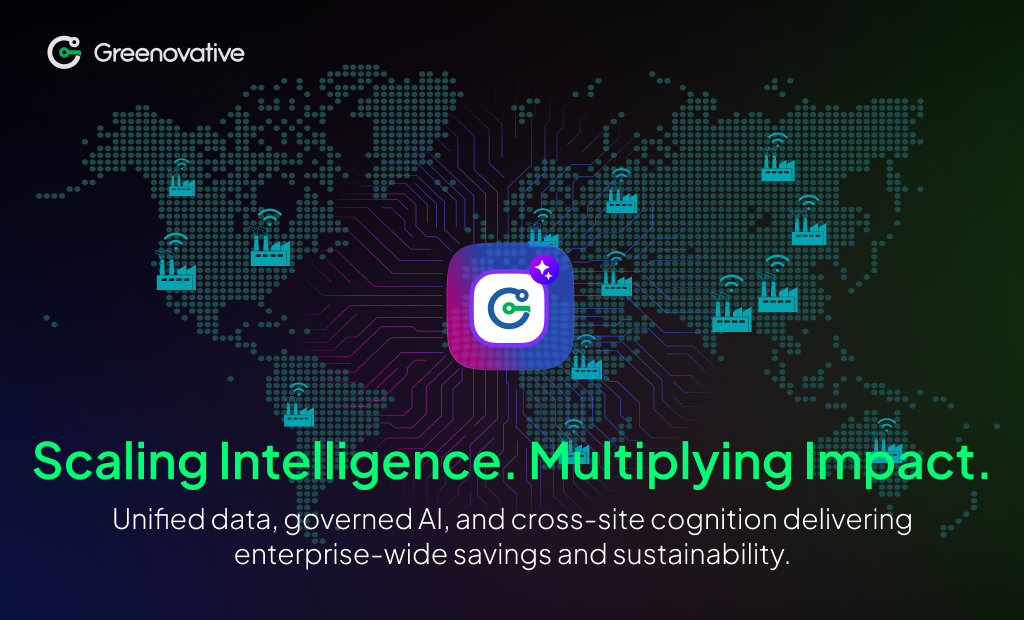
What manufacturers need isn’t more dashboards or localized models. They need a horizontal intelligence layer that connects data and decisions across plants, utilities, and business functions.

This layer ensures that insights discovered in one facility can instantly inform others, creating a single cognitive framework where AI learns collectively and prescribes consistently. It bridges the gap between localized analytics and enterprise-level decision intelligence, making every action explainable, repeatable, and governed under one logic.

Greenovative’s Approach to Enterprise Impact

At Greenovative, we design AI that scales intelligence, not software. Greenovative platform transforms scattered site data into one enterprise operational graph, empowering organizations to manage performance, cost, and carbon holistically.

  • Unified Data Architecture:

    All sites, utilities, and systems feed into a normalized data model that enables unified KPIs and cross-site visibility.

  • Centralized AI Governance:

    Ensures consistent interpretation, transparent logic, and regulatory compliance across global operations.

  • Cross-Functional Intelligence:

    Connects energy, asset, and sustainability layers, turning isolated optimizations into enterprise-wide efficiency.

  • Modular AI Design:

    Each site adapts the core AI to local conditions while enriching the global learning loop, making every deployment smarter.

The result is an enterprise that doesn’t just monitor; it understands, learns, and prescribes actions with measurable business outcomes.

Outcomes of True Enterprise AI

Organizations adopting Greenovative AI report tangible, repeatable value:

  • Cross-Site Benchmarking:

    Standardized metrics reveal which plants lead or lag, enabling targeted interventions.

  • Faster Replication of Best Practices:

    Proven optimizations in one unit can be applied across the network within weeks, not quarters.

  • Unified ROI and Carbon Visibility:

    CXOs gain consolidated oversight of financial savings, energy intensity, and emission reductions across the enterprise.

  • Continuous Improvement at Scale:

    Every plant’s experience strengthens the collective model, creating a self-learning organization.

Across global deployments, Greenovative has enabled over $20 million in verified savings, 470,000 tons of CO₂e reductions, and ROI within 18 months, proof that prescriptive, enterprise-wide AI delivers measurable impact far beyond analytics.

Conclusion: Scaling Intelligence, Not Just Software

Industrial AI maturity isn’t defined by the number of pilots; it’s measured by how consistently an organization converts data into action across every plant and process.
The future belongs to manufacturers that treat intelligence as shared infrastructure, not a local experiment.

Greenovative enables that future by embedding cognition into the enterprise fabric, so every decision, from energy dispatch to carbon strategy, is informed by data, guided by AI, and measured by results.

Enterprise AI – From Reports to Results

In many enterprises today, what’s called “AI” is often just dashboards or BI tools with smarter visuals. They tell decision-makers what happened, but rarely why, and almost never prescribe what to do next.

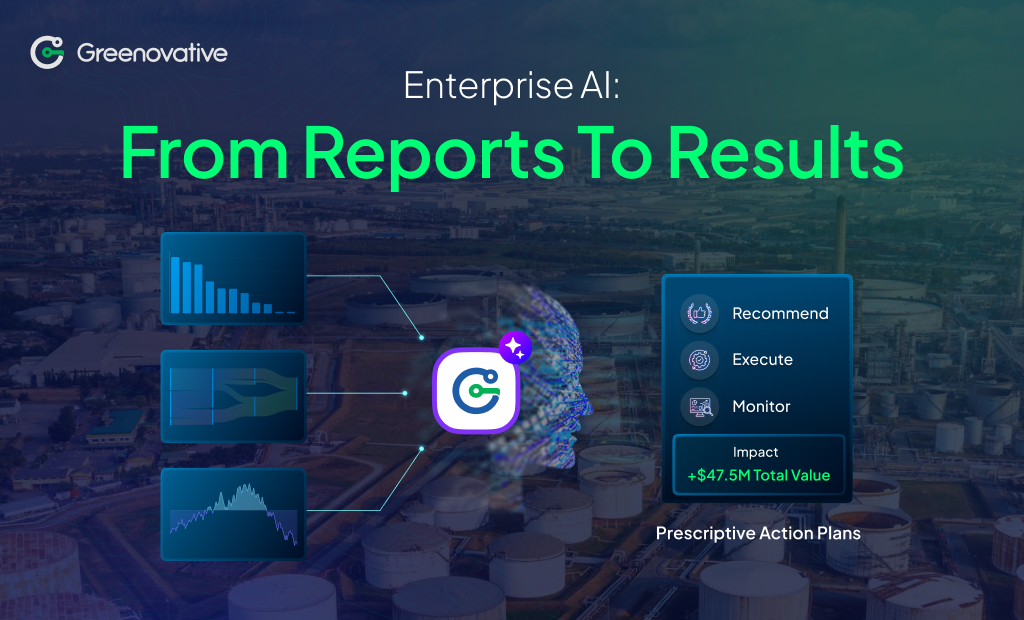
The real leap is from descriptive tools to prescriptive intelligence, an AI that behaves like a strategic advisor, interpreting complexity, recommending high-impact actions, and driving real outcomes.

Why Most “Enterprise AI” Today Is Just Dressed-Up BI

  • Data-rich, insight-poor: According to industry forecasts, the global enterprise AI market is estimated at USD 97.2 billion in 2025, climbing to USD 229.3 billion by 2030 (CAGR ~18.9 %). Yet many adopters remain stuck at dashboards.
  • Descriptive bias: Most systems focus on aggregation, trend-lines, and alerts, showing correlations or past deviations, but not giving causal clarity.
  • Action gap: Even when insights emerge, translating them into executable decisions often remains with human teams, introducing delays, inefficiencies, and guesswork.
  • Siloed intelligence: AI deployments often live within functions (supply chain, maintenance, energy) with little cross-domain decision coordination, limiting strategic coherence.

The gap is clear: dashboards tell, but don’t act. Strategy leaders and CFOs increasingly demand AI that turns data into decisions, not just insights.

What True Enterprise AI Looks Like

The shift is from “reporting AI” to prescriptive, decision-intelligence AI. The key traits:

  1. Interprets Complexity
    Advanced models ingest multiple domain signals (e.g. energy management system, operations, maintenance, market data) simultaneously and decode interdependencies.
  2. Prescribes Clear Actions
    Instead of issuing alerts, the system recommends optimized interventions (e.g. reroute load, change schedule, modulate inputs) with expected metrics (e.g. cost savings, risk reduction).
  3. Simulates & Validates
    It runs “what-if” scenario simulations, quantifies trade-offs, and refines suggestions based on real-world feedback.
  4. Drives Outcomes
    It doesn’t stop at suggestions, monitors execution, verifies results, and adapts continuously.
  5. Acts as Strategic Advisor
    It elevates from an operational tool to a partner in planning: linking decisions to P&L, carbon, risk, and competitive positioning.

One research direction, for example, is PresAIse, a prescriptive AI framework enabling users to interact via natural language, interpret causal inference, and suggest decisions in enterprise contexts.

From Insight to Impact

Consider a manufacturing company that observed repeated supply-chain disruptions. Their “AI” dashboard flagged frequent delays and rising costs, but didn’t propose why or how to fix them.

A real enterprise AI system delved deeper:

  • Mapped order-to-fulfilment times against machine downtime, raw material variances, and logistics patterns.
  • Prescribed an action: shift loading of specific SKUs to alternate lines during weather-forecasted delays.
  • Simulated the projected gain: a 4 % cost reduction and 8 % improvement in on-time delivery.

This is not magic, it’s AI as strategic advisor, turning raw data into executed decisions.

Key Benefits for Strategy & Finance

  • Higher ROI on data assets: You stop investing in dashboards and begin capturing value from them.
  • Shorter decision cycles: From insight to action in hours, not weeks.
  • Risk reduction: Because decisions come with built-in simulations and validation.
  • Scalable decision capacity: Human leaders remain in control, but AI supports high-velocity, multi-parameter trade-offs.
  • Competitive differentiation: Companies that operationalize AI beyond reporting can outperform peers by 5–15 % on margins, agility, and innovation.

Adopting Enterprise AI: Key Considerations

  • Data infrastructure maturity: You need solid pipelines, clean models, and cross-domain integration.
  • Model transparency & interpretability: Business users must understand why the system makes certain suggestions.
  • Responsible AI governance: Decisions must be auditable, traceable, and aligned with regulatory/ethical frameworks.
  • Continuous feedback loop: The system must learn from outcomes to refine prescriptions.

According to Wikipedia’s definition of prescriptive analytics, this stage of analytics “suggests decision options… and shows implications of each decision option,” advancing significantly beyond descriptive and predictive models.

From Reports to Impact

Enterprises that lean on dashboards alone are operating at a plateau. The true frontier of AI lies in prescriptive, decision-intelligence systems, where AI is not a passive tool but an active advisor.

Moving from insight to impact means:

  • recognizing that AI must prescribe, not only report;
  • integrating cross-domain signals;
  • validating recommended actions;
  • and closing the loop on execution and outcomes.

If your current AI feels more like visualization than transformation, it’s time to reframe: AI should not just show you what’s happening, but tell you what to do next, predict what will happen, and ensure the results follow.

AI in Manufacturing: Beyond Human Intuition

Artificial Intelligence in manufacturing is no longer experimental; it’s mainstream.
According to the World Economic Forum, factories that have adopted AI-driven operations report 10–20% performance improvement and significant energy efficiency gains. Similarly, IBM Research notes that
AI-enabled analytics can reduce energy waste and improve decision accuracy across complex production environments.

Yet despite these advances, most industrial decisions still depend heavily on human intuition, experience-based judgment shaped by years on the shop floor.
That experience remains invaluable, but in an era of hyper-connected systems and billions of data points, intuition alone isn’t enough.

The Limits of Human Intuition

Human intuition is powerful,  but inherently constrained:

  • Limited data bandwidth: Even the best engineers can track a few dozen variables, while a typical plant streams data from thousands of sensors.
  • Memory bias: Operators rely on precedent, “this happened last summer”, which may not apply under new production or tariff conditions.
  • Blind spots: Subtle issues like baseload drift, reactive power penalties, or hidden emission spikes emerge gradually and across systems, easily escaping manual detection.
  • Unquantified outcomes: Intuition suggests what’s wrong but rarely tells how much it costs or which action yields maximum return.

As manufacturing grows more data-dense, these limitations directly translate into cost, carbon, and competitiveness gaps.

How AI Augments Intuition

AI doesn’t replace human judgment, it strengthens it.

  1. Continuous data scanning – AI processes live feeds from energy meters, SCADA, EMS, and process sensors, identifying abnormal behavior across assets and shifts.
  2. Contextual pattern recognition – By learning plant-specific baselines, it recognizes deviations long before they show in KPIs or bills.
  3. Prescriptive guidance – Instead of just flagging anomalies, AI quantifies potential savings and prescribes clear, actionable steps, translating analytics into ROI.

This combination of breadth (data scale) and depth (context) turns reactive decisions into predictive, repeatable improvements.

A Real-World Example

When a plant’s Specific Energy Consumption (SEC) began to rise, engineers assumed it was due to increased production demand.
AI traced the cause elsewhere: idle baseload creep and off-shift equipment runtime. By prescribing optimized scheduling and automated shutdown sequences, the system cut energy costs by 8%, with zero CAPEX.

This is what happens when intuition meets intelligence, AI quantifies what experience suspects.

Why This Matters for CFOs & Strategy Leaders

Every inefficiency uncovered is a direct financial opportunity.

As the World Economic Forum observes, the “Lighthouse” factories adopting AI across operations demonstrate sustained competitiveness, not just incremental improvement.

From Instinct to Quantified Action

Traditional Approach AI-Augmented Approach
Experience + observation Billions of data points + prescriptive insight
Alerts without context Actions with quantified ROI & CO₂ impact
Reactive fixes Predictive, preventive decision-making
Siloed visibility Unified, cross-system intelligence

Human intuition remains irreplaceable; it provides context, creativity, and understanding of the plant’s pulse.
But AI extends that intuition to a new dimension, continuous, quantified, and cost-linked.

When both work together, every hidden inefficiency becomes a measurable opportunity, and every decision becomes a data-backed advantage.

If rising SEC or unexplained energy spikes still feel like “normal drift,” it’s time to let AI show the numbers behind the intuition.

AI in Manufacturing: The Proven Playbook for ROI and Sustainability

Manufacturers Who Bet on Outcomes, Not Hype

AI in manufacturing has moved beyond pilots; it’s now a practical driver of measurable results. From pharmaceuticals and automotive to steel, textiles, and food & beverages, leading industries are adopting AI to reduce waste, stabilise production, and accelerate their sustainability goals.

At the centre of this shift is Greenovative’s AI Playbook, trusted by 100+ customers in 10+ countries, including 20% of top-10 industry leaders. The reason is simple: it delivers measurable outcomes, not just dashboards.

For leaders in operations, energy, or ESG, the need is clear: you don’t need more data to monitor. You need intelligence that translates into action, savings, and ROI within months, not years.

The Problem: Pilots, Dashboards… and stalled value

Most AI programs stall for the same reasons:

  • Fragmented data scattered across plants, lines, and assets
  • Monitoring that only shows what happened, not what to do next
  • Energy and ESG data not linked to P&L or risk
  • Inconsistent KPIs across facilities, killing comparability and momentum
  • Lack of domain expertise to turn data into action

The result is familiar: long pilots, limited adoption, and “interesting insights” that remain stuck in presentations rather than driving daily operations or measurable financial outcomes.

The Playbook: How Top Players Make AI Pay Back

Greenovative’s AI playbook is pragmatic. It’s built to move from signal → decision → verified impact:

  1. Model the reality you operate in
    “Ingest tariffs, production shifts, asset behavior, and OEM specs, layered with weather and external factors. This is where Greenovative’s AI Playbook differs: it understands industrial context, not just sensor noise.”
  2. Standardize KPIs and baselines
    Align on energy intensity per unit, CO₂e per operating hour, water footprint per line, applied uniformly across plants. Comparable KPIs unlock comparable performance.
  3. Prescribe, don’t just predict
    Get next-best actions: load sequencing, part-load optimization, shutdown windows, TOD alignment, and PPA corrections. Greenovative’s prescription intelligence tells teams what to do, when, and why.
  4. Close the financial loop
    Every recommendation comes with expected savings, payback, and emission impact. Finance.
  5. Prove, scale, repeat
    Start with one line or utility, verify impact, then scale with playbook templates. The method compounds across sites and geographies.

The Impact: What Leaders Are Achieving

  • Greenovative undertakes guarantee at least  5% cost savings
  • A leading pharma facility unlocked USD 0.5 Mn/year by realigning TOD and tightening penalty exposure, guided by Greenovative’s billing intelligence.
  • A top automotive supplier cut idle load and runtime drift, saving USD 0.34 Mn/year with prescriptive load sequencing delivered by Greenovative Utility AI.

Why top players choose this approach

  • Enterprise-grade trust patented methods, audit-ready trails, and compliance alignment (ISO/GDPR-aligned practices).
  • Proven at scale: trained on 1,000+ TB of industrial datasets, 2,000+ KPI signatures, patented algorithms, and multi-site industrial data, ensuring adaptability across sectors.

With Greenovative’s advanced industrial AI, teams don’t argue over data, they act on it.

Your Next Step: Turn Intelligence into Advantage

The world’s top most industries already have their AI playbook. Do you?

If you want fewer pilots and faster payback, start where value is immediate: utility efficiency, billing intelligence, and energy mix optimization. Then scale across plants with standardized KPIs and a common savings language.

Book an AI Prescription Demo and see how Greenovative Energy’s platform moves from detection to decision to documented impact, in weeks.

AI In Manufacturing: Turning Solar installations into Measurable ROI

A Manufacturing Shift Powered by Solar

Across industries, manufacturers have turned to solar as a powerful step toward sustainability and savings. “Solar arrays feed generation meters, with dashboards showcasing ‘green energy produced.’”

Every unit of energy consumed or produced carries a direct financial implication. Many manufacturers have already invested in solar to cut costs and reduce carbon footprints. Yet, a crucial question often remains unanswered;

“How do we measure the true financial value of our solar investments?”

This is where Solar AI steps in as the hero, empowering organizations to see beyond just kilowatt-hours and truly connect solar energy generation with measurable business returns.

When Data Stops at Generation

Traditional solar monitoring platforms provide limited insights. They track how much energy your panels generate but fail to tell you:

  • Whether that generation translates into real savings.
  • If performance degradation is silently eroding returns.
  • Where opportunities for expansion, storage, or export optimization exist.

For manufacturing facilities, where margins are tight and energy is a critical cost driver, this gap between generation data and financial reality creates uncertainty. Leaders cannot make informed decisions about costs and earnings with only half the picture.

Bridging Generation & Financial Value with Solar AI

Solar AI transforms raw data into actionable intelligence. By combining advanced solar analytics with financial modelling, it helps manufacturers close the loop between what is generated and what is saved.

Here’s how:

  1. Advanced Solar Analytics for Precision
    “With Greenovative’s advanced solar analytics, manufacturers gain real-time visibility into solar performance. It doesn’t just show ‘energy produced’; it highlights efficiency, tracks how solar offsets grid consumption, identifies anomalies, and prescribes corrective actions for underperforming assets.”
  2. From Energy Data to Financial Impact
    Solar AI directly links generation with cost savings, giving leaders a clear view of their financial impact and realization. Instead of just kilowatt reports, businesses see how much they’ve saved, how fast ROI is being achieved, and what strategies will maximize solar ROI further.
  3. Opportunity for Expansion & Growth
    Manufacturing operations are dynamic. Solar AI identifies opportunities for expansion, whether it’s storage integration, peak load optimization, or energy export strategies. This ensures businesses are always ahead with a data-led energy strategy.
  4. Sustainability with Profitability
    Beyond compliance or sustainability goals, Solar AI makes renewable adoption a revenue-positive decision. By bridging generation & savings, it positions green energy not just as a CSR move but as a financial advantage.

Why It Matters to you

If you’re in an energy-intensive industry. With fluctuating demand, machinery loads, and rising tariffs, every inefficiency directly impacts profitability. Solar AI empowers you to:

  • Detect and correct system inefficiencies early.
  • Align sustainability goals with bottom-line impact.
  • Scale renewable adoption with confidence.

With this shift, manufacturers no longer ask, “How much energy did we generate?” but instead ask, “How much value did we realize?”

The Greenovative Edge

At Greenovative, we believe solar must be more than numbers on a dashboard. Our Solar AI solutions deliver a complete view of energy generation, financial impact, and growth opportunities, tailored for manufacturing industries.

By transforming solar monitoring into a data-led energy strategy, Greenovative helps organizations move from generation data to business intelligence. The result? Smarter investments, maximized savings, and measurable progress toward net-zero goals.

Turning Solar into real value

The future of industry is not just about adopting renewable energy, it’s about making every unit of energy work harder for your business. Solar AI translates sunlight into measurable savings, smarter financial decisions, and long-term growth.

With Greenovative’s advanced solar analytics, organizations gain a clear path to maximize ROI, strengthen sustainability, and achieve a lasting competitive edge.

Unlocking Hidden Efficiency: How AI Turns Industrial Data into Actionable Intelligence

Industrial plants today have everything they need to succeed: skilled teams, powerful machines, and an ocean of data. The real opportunity lies in turning that data into intelligence. Intelligence that drives efficiency, sustainability, and smarter decisions every day.

This is where Artificial Intelligence (AI) is transforming industry. It doesn’t just automate tasks. It empowers your plant to think, adapt, and act in real time, unlocking savings and opportunities that were once invisible.

The Rise of Intelligent Industry

Imagine a plant that:

  • Detects hidden process inefficiencies like leaks, idle loads, or underperforming chillers before they drain profits
  • Optimizes multi-utility loads in real time, cutting peak energy demand and unlocking double-digit cost savings
  • Delivers live cost-per-unit and CO₂ footprint for every production run, aligning operations with ESG targets effortlessly

This isn’t a future vision. It is happening today with AI-powered industrial intelligence.
By connecting siloed data across machines, sensors, and enterprise systems, AI delivers real-time, actionable insights that help every decision-maker, from the shop floor to the boardroom, act with confidence.

How AI Turns Data into Actionable Intelligence

AI reshapes the industrial mindset, moving from reactive to proactive, and from guesswork to clarity.

  1. Breaks Down Data Silos
    AI unifies data from production lines, utilities, maintenance, and sustainability platforms into one real-time intelligence layer.
  2. Detects What Matters, Instantly
    Contextual algorithms separate signal from noise, flagging anomalies like pressure spikes or abnormal vibration before they escalate into downtime or losses.
  3. Aligns Operations with Efficiency & ESG Goals
    Every decision, from equipment load balancing to production adjustments, directly supports cost savings, energy efficiency, and sustainability objectives.
  4. Learns, Adapts, and Optimizes Continuously
    With every cycle, AI evolves. It predicts risks earlier, improves yield, and unlocks new efficiencies automatically.

Example:

A leading automotive supplier used Greenovative AI to optimize its compressed air network and detect suboptimal furnace operations.
Within 90 days, the plant achieved 11% energy savings, avoided 14 tons of CO₂ emissions, and reduced unplanned downtime by 8%.

From Smarter Plants to Sustainable Growth

AI doesn’t replace people. It amplifies human decision-making.

  • Operators gain instant alerts and clear next steps
  • Managers see production, energy, and emissions performance in one real-time view
  • Leadership can confidently scale efficiency and ESG performance across multiple sites

When data transforms into intelligence, your plant doesn’t just perform. It thrives, continuously improving efficiency, reliability, and sustainability.

Greenovative: Engineering Intelligence That Performs

At Greenovative Energy, we integrate AI into the very DNA of industrial operations:

  • Seamless integration with legacy machines, IoT, and ERP
  • Predictive analytics for energy, water, emissions, and process optimization
  • Adaptive intelligence that evolves with your plant for continuous improvement

Your plant already has the data. Let’s unlock the intelligence hidden inside it.

Inside the Brain: How Greenovative AI Works at Industrial Scale

Imagine saving 15% on energy and operations just by making a few strategic tweaks; not guesses, but data-backed decisions. Now imagine having an intelligent assistant that not only sees the invisible patterns across thousands of machines but also guides you step-by-step to optimize performance, reduce waste, and unlock efficiency. That’s the power of Greenovative AI.

In today’s fast-moving industrial world, leaders don’t need more data; they need meaningful direction. Greenovative AI Platform was built for exactly that: making complex operations smarter, faster, and more sustainable with deep intelligence.

The world no longer needs more data. It needs smarter ways to make data work.

That’s where the Greenovative AI Platform steps in.

Greenovative AI Platform: Built for Real-World Complexity

The Greenovative AI Platform is not just another tool. It’s a purpose-built intelligence engine created for industrial environments. Trained on over 1000+ TB of real operational data and refined through 2000+ asset KPI signatures, it brings industrial AI to life at global scale.

It doesn’t sit outside your operations. It becomes part of it, adapting to live conditions, integrating with existing systems, and continuously learning to deliver better outcomes.

Contextual Intelligence: Understand, Don’t Just Analyze

Manufacturing isn’t just about machines; it’s about interdependent systems, legacy workflows, and round-the-clock operations. From the control room to shop floor, every process affects the next. But traditional monitoring tools miss this interconnection.

Greenovative AI goes beyond raw data to understand context, how a variation in one system influences multiple downstream outcomes. For example, a minor valve miscalibration may seem insignificant, but when viewed contextually, it may signal larger inefficiencies across power, cooling, or emissions.

That’s why contextual intelligence is not a buzzword for us; it’s the foundation for industrial clarity.

System Integration: Turn Silos into Smart Networks

Industrial ecosystems are often fragmented, legacy systems, isolated tools, and disconnected data sources. Greenovative AI Platform breaks through these silos.

It integrates seamlessly with SCADA, ERP, EMS, IoT frameworks, and more. The result? A unified layer of intelligence that provides real-time visibility, control, and optimization across all levels of operations.

This is what transformation looks like in action.

Prescriptive Analytics: Know What to Do Next

Diagnostics tell you what went wrong. Predictions tell you what might go wrong. But prescriptive analytics tells you what to do about it.

Greenovative AI doesn’t stop at insights, it recommends actions. Whether it’s adjusting operational parameters or alerting teams with specific next steps, it empowers decision-makers to move from guesswork to precision.

This is where data turns into decisions. Fast, confident, and effective.

Driving Impact Where It Matters Most

Industries that adopt Greenovative AI Platform don’t just automate; to drive visible outcomes

They reduce energy usage, cut down emissions, improve asset reliability, and streamline workflows. They shift from reactive firefighting to strategic foresight. And most importantly, they future-proof their operations for the challenges ahead.

Because in a world that changes by the minute, only those who act with intelligence will lead the way.

Greenovative AI Platform isn’t the future.
It’s how the future works.