






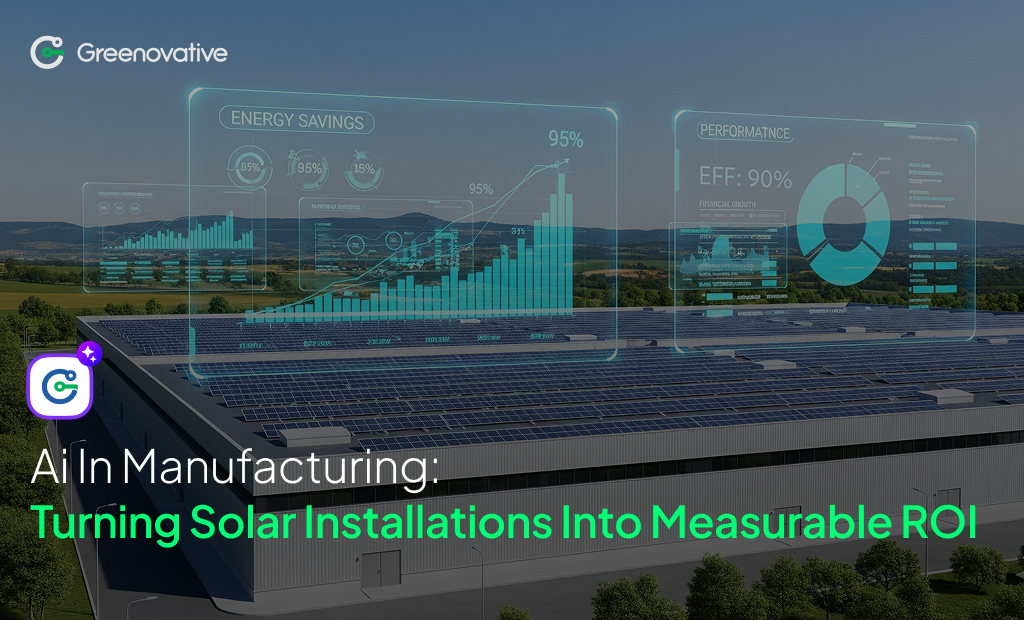
AI In Manufacturing: Turning Solar installations into Measurable ROI

A Manufacturing Shift Powered by Solar

Across industries, manufacturers have turned to solar as a powerful step toward sustainability and savings. “Solar arrays feed generation meters, with dashboards showcasing ‘green energy produced.’”

Every unit of energy consumed or produced carries a direct financial implication. Many manufacturers have already invested in solar to cut costs and reduce carbon footprints. Yet, a crucial question often remains unanswered;

“How do we measure the true financial value of our solar investments?”

This is where Solar AI steps in as the hero, empowering organizations to see beyond just kilowatt-hours and truly connect solar energy generation with measurable business returns.

When Data Stops at Generation

Traditional solar monitoring platforms provide limited insights. They track how much energy your panels generate but fail to tell you:

  • Whether that generation translates into real savings.
  • If performance degradation is silently eroding returns.
  • Where opportunities for expansion, storage, or export optimization exist.

For manufacturing facilities, where margins are tight and energy is a critical cost driver, this gap between generation data and financial reality creates uncertainty. Leaders cannot make informed decisions about costs and earnings with only half the picture.

Bridging Generation & Financial Value with Solar AI

Solar AI transforms raw data into actionable intelligence. By combining advanced solar analytics with financial modelling, it helps manufacturers close the loop between what is generated and what is saved.

Here’s how:

  1. Advanced Solar Analytics for Precision
    “With Greenovative’s advanced solar analytics, manufacturers gain real-time visibility into solar performance. It doesn’t just show ‘energy produced’; it highlights efficiency, tracks how solar offsets grid consumption, identifies anomalies, and prescribes corrective actions for underperforming assets.”
  2. From Energy Data to Financial Impact
    Solar AI directly links generation with cost savings, giving leaders a clear view of their financial impact and realization. Instead of just kilowatt reports, businesses see how much they’ve saved, how fast ROI is being achieved, and what strategies will maximize solar ROI further.
  3. Opportunity for Expansion & Growth
    Manufacturing operations are dynamic. Solar AI identifies opportunities for expansion, whether it’s storage integration, peak load optimization, or energy export strategies. This ensures businesses are always ahead with a data-led energy strategy.
  4. Sustainability with Profitability
    Beyond compliance or sustainability goals, Solar AI makes renewable adoption a revenue-positive decision. By bridging generation & savings, it positions green energy not just as a CSR move but as a financial advantage.

Why It Matters to you

If you’re in an energy-intensive industry. With fluctuating demand, machinery loads, and rising tariffs, every inefficiency directly impacts profitability. Solar AI empowers you to:

  • Detect and correct system inefficiencies early.
  • Align sustainability goals with bottom-line impact.
  • Scale renewable adoption with confidence.

With this shift, manufacturers no longer ask, “How much energy did we generate?” but instead ask, “How much value did we realize?”

The Greenovative Edge

At Greenovative, we believe solar must be more than numbers on a dashboard. Our Solar AI solutions deliver a complete view of energy generation, financial impact, and growth opportunities, tailored for manufacturing industries.

By transforming solar monitoring into a data-led energy strategy, Greenovative helps organizations move from generation data to business intelligence. The result? Smarter investments, maximized savings, and measurable progress toward net-zero goals.

Turning Solar into real value

The future of industry is not just about adopting renewable energy, it’s about making every unit of energy work harder for your business. Solar AI translates sunlight into measurable savings, smarter financial decisions, and long-term growth.

With Greenovative’s advanced solar analytics, organizations gain a clear path to maximize ROI, strengthen sustainability, and achieve a lasting competitive edge.


Unlocking Hidden Efficiency: How AI Turns Industrial Data into Actionable Intelligence

Industrial plants today have everything they need to succeed: skilled teams, powerful machines, and an ocean of data. The real opportunity lies in turning that data into intelligence. Intelligence that drives efficiency, sustainability, and smarter decisions every day.

This is where Artificial Intelligence (AI) is transforming industry. It doesn’t just automate tasks. It empowers your plant to think, adapt, and act in real time, unlocking savings and opportunities that were once invisible.

The Rise of Intelligent Industry

Imagine a plant that:

  • Detects hidden process inefficiencies like leaks, idle loads, or underperforming chillers before they drain profits
  • Optimizes multi-utility loads in real time, cutting peak energy demand and unlocking double-digit cost savings
  • Delivers live cost-per-unit and CO₂ footprint for every production run, aligning operations with ESG targets effortlessly

This isn’t a future vision. It is happening today with AI-powered industrial intelligence.
By connecting siloed data across machines, sensors, and enterprise systems, AI delivers real-time, actionable insights that help every decision-maker, from the shop floor to the boardroom, act with confidence.

How AI Turns Data into Actionable Intelligence

AI reshapes the industrial mindset, moving from reactive to proactive, and from guesswork to clarity.

  1. Breaks Down Data Silos
    AI unifies data from production lines, utilities, maintenance, and sustainability platforms into one real-time intelligence layer.
  2. Detects What Matters, Instantly
    Contextual algorithms separate signal from noise, flagging anomalies like pressure spikes or abnormal vibration before they escalate into downtime or losses.
  3. Aligns Operations with Efficiency & ESG Goals
    Every decision, from equipment load balancing to production adjustments, directly supports cost savings, energy efficiency, and sustainability objectives.
  4. Learns, Adapts, and Optimizes Continuously
    With every cycle, AI evolves. It predicts risks earlier, improves yield, and unlocks new efficiencies automatically.

Example:

A leading automotive supplier used Greenovative AI to optimize its compressed air network and detect suboptimal furnace operations.
Within 90 days, the plant achieved 11% energy savings, avoided 14 tons of CO₂ emissions, and reduced unplanned downtime by 8%.

From Smarter Plants to Sustainable Growth

AI doesn’t replace people. It amplifies human decision-making.

  • Operators gain instant alerts and clear next steps
  • Managers see production, energy, and emissions performance in one real-time view
  • Leadership can confidently scale efficiency and ESG performance across multiple sites

When data transforms into intelligence, your plant doesn’t just perform. It thrives, continuously improving efficiency, reliability, and sustainability.

Greenovative: Engineering Intelligence That Performs

At Greenovative Energy, we integrate AI into the very DNA of industrial operations:

  • Seamless integration with legacy machines, IoT, and ERP
  • Predictive analytics for energy, water, emissions, and process optimization
  • Adaptive intelligence that evolves with your plant for continuous improvement

Your plant already has the data. Let’s unlock the intelligence hidden inside it.

Maximizing Utility Efficiency: Unlocking Savings Without Core Process Changes

Introduction

Operational efficiency is a critical driver of profitability and sustainability for industrial organizations. While most efficiency initiatives focus on improving core production processes, significant gains can be achieved by optimizing utilities such as energy, water, compressed air, and HVAC systems. These utility systems often operate in the background, but their impact on costs, resource consumption, and environmental sustainability is substantial. By focusing on utilities, organizations can enhance efficiency without disrupting their core processes, ensuring smooth operations while driving measurable improvements.

This blog explores strategies to optimize utilities and highlights how advanced technologies enable organizations to reduce costs, conserve resources, and align with sustainability goals.

The Importance of Utility Optimization
According to a report by the International Energy Agency (IEA), improved utility efficiency could reduce global energy demand by nearly 10% by 2030, significantly contributing to carbon emissions reductions. Additionally, a World Economic Forum study highlights that utility optimization efforts in industrial sectors could save businesses over $600 billion annually while aligning with global sustainability goals.
Utilities form the backbone of industrial operations, providing the energy, water, and resources needed to power equipment and maintain optimal environmental conditions. Key reasons to prioritize utility optimization include:

  • Cost Savings: Utility systems account for up to 30% of operational costs in many industries. Optimizing these systems can significantly reduce expenditures.
  • Sustainability Goals: Efficient utilities contribute to reducing carbon footprints, aligning operations with global sustainability initiatives.
  • Operational Resilience: Optimized utility systems ensure reliability, reducing downtime caused by utility-related failures.

Key Areas for Utility Optimization

  1. Energy Management
  2. Water Management
  3. Compressed Air Systems
    • Leak Prevention: Use automated monitoring systems to detect leaks in compressed air systems, which can account for up to 30% of system inefficiencies.
    • Pressure Optimization: Maintain optimal pressure levels to minimize energy consumption while ensuring adequate performance.
    • Smart Controls: Implement intelligent control systems to adjust airflow based on real-time demand.
  4. HVAC Optimization
    • Smart Thermostats: Use AI-powered thermostats to automatically adjust temperatures based on occupancy and ambient conditions.
    • Ventilation Efficiency: Optimize airflow systems to maintain air quality while reducing energy consumption.
    • Maintenance Alerts: Predictive maintenance tools identify potential HVAC issues before they escalate, reducing downtime and repair costs.

How Technology Enables Utility Optimization

  1. IoT Sensors for Real-Time Monitoring
    • IoT devices provide granular visibility into utility usage across facilities, enabling organizations to identify inefficiencies immediately.
    • Real-time data collection ensures that anomalies, such as leaks or energy spikes, are addressed proactively.
  2. AI-Driven Analytics
    • Predictive analytics models forecast utility demands and recommend adjustments to improve efficiency.
    • AI tools enable dynamic adjustments to energy, water, and air systems based on production schedules and operational needs.
  3. Centralized Utility Management Platforms
    • Digital platforms consolidate data from utility systems, providing a unified view of resource consumption across facilities.
    • Benchmarking tools allow organizations to compare utility performance across sites and implement best practices.

Case Studies: Real-World Applications of Utility Optimization

  1. Energy Recovery in Manufacturing: A global steel manufacturer implemented waste heat recovery systems, reducing energy costs by 18% and lowering emissions by 25%.
  2. Water Reuse in Automotive Plants: An automotive manufacturer installed water recycling systems, achieving a 40% reduction in water consumption across its facilities.
  3. Compressed Air Monitoring in Food Processing: A food processing plant used IoT-enabled compressed air monitoring systems, reducing energy waste by 22% through leak detection and pressure optimization.

The Benefits of Utility Optimization
Optimizing utilities delivers a range of benefits, including:

  • Lower Operational Costs: Reduced energy and resource consumption leads directly to cost savings.
  • Improved Sustainability: Utility optimization contributes to ESG goals by minimizing waste and emissions.
  • Enhanced Reliability: Proactive maintenance and real-time monitoring reduce downtime and ensure consistent utility performance.
  • Scalability: Optimized utility systems can easily adapt to changes in production demands, ensuring long-term operational resilience.

Actionable Steps for Organizations

  1. Conduct Utility Audits: Identify inefficiencies and prioritize optimization opportunities across energy, water, compressed air, and HVAC systems.
  2. Invest in Smart Technology: Deploy IoT sensors, AI analytics, and centralized platforms to monitor and manage utilities effectively.
  3. Set Clear Goals: Align utility optimization efforts with measurable objectives, such as cost reductions or emissions targets.
  4. Collaborate Across Teams: Engage stakeholders from operations, maintenance, and sustainability teams to drive initiatives.
  5. Continuously Monitor and Refine: Use data-driven insights to refine optimization strategies and scale successful implementations.

Conclusion: Unlocking Efficiency Through Utility Optimization
Utility systems represent a significant opportunity for organizations to drive efficiency and sustainability without disrupting core production processes. By leveraging advanced technologies and focusing on key areas such as energy, water, compressed air, and HVAC systems, organizations can achieve measurable improvements in cost savings, resource conservation, and operational reliability.

In an increasingly competitive and sustainability-focused world, optimizing utilities is not just a smart strategy—it’s a necessity. For leaders, the path to operational excellence starts with taking a closer look at the systems that power their operations. Are you ready to unlock the potential of utility optimization?

Click here to schedule a demo or contact our sales team to learn more.