






AI in Manufacturing: The Proven Playbook for ROI and Sustainability

Manufacturers Who Bet on Outcomes, Not Hype

AI in manufacturing has moved beyond pilots; it’s now a practical driver of measurable results. From pharmaceuticals and automotive to steel, textiles, and food & beverages, leading industries are adopting AI to reduce waste, stabilise production, and accelerate their sustainability goals.

At the centre of this shift is Greenovative’s AI Playbook, trusted by 100+ customers in 10+ countries, including 20% of top-10 industry leaders. The reason is simple: it delivers measurable outcomes, not just dashboards.

For leaders in operations, energy, or ESG, the need is clear: you don’t need more data to monitor. You need intelligence that translates into action, savings, and ROI within months, not years.

The Problem: Pilots, Dashboards… and stalled value

Most AI programs stall for the same reasons:

  • Fragmented data scattered across plants, lines, and assets
  • Monitoring that only shows what happened, not what to do next
  • Energy and ESG data not linked to P&L or risk
  • Inconsistent KPIs across facilities, killing comparability and momentum
  • Lack of domain expertise to turn data into action

The result is familiar: long pilots, limited adoption, and “interesting insights” that remain stuck in presentations rather than driving daily operations or measurable financial outcomes.

The Playbook: How Top Players Make AI Pay Back

Greenovative’s AI playbook is pragmatic. It’s built to move from signal → decision → verified impact:

  1. Model the reality you operate in
    “Ingest tariffs, production shifts, asset behavior, and OEM specs, layered with weather and external factors. This is where Greenovative’s AI Playbook differs: it understands industrial context, not just sensor noise.”
  2. Standardize KPIs and baselines
    Align on energy intensity per unit, CO₂e per operating hour, water footprint per line, applied uniformly across plants. Comparable KPIs unlock comparable performance.
  3. Prescribe, don’t just predict
    Get next-best actions: load sequencing, part-load optimization, shutdown windows, TOD alignment, and PPA corrections. Greenovative’s prescription intelligence tells teams what to do, when, and why.
  4. Close the financial loop
    Every recommendation comes with expected savings, payback, and emission impact. Finance.
  5. Prove, scale, repeat
    Start with one line or utility, verify impact, then scale with playbook templates. The method compounds across sites and geographies.

The Impact: What Leaders Are Achieving

  • Greenovative undertakes guarantee at least  5% cost savings
  • A leading pharma facility unlocked USD 0.5 Mn/year by realigning TOD and tightening penalty exposure, guided by Greenovative’s billing intelligence.
  • A top automotive supplier cut idle load and runtime drift, saving USD 0.34 Mn/year with prescriptive load sequencing delivered by Greenovative Utility AI.

Why top players choose this approach

  • Enterprise-grade trust patented methods, audit-ready trails, and compliance alignment (ISO/GDPR-aligned practices).
  • Proven at scale: trained on 1,000+ TB of industrial datasets, 2,000+ KPI signatures, patented algorithms, and multi-site industrial data, ensuring adaptability across sectors.

With Greenovative’s advanced industrial AI, teams don’t argue over data, they act on it.

Your Next Step: Turn Intelligence into Advantage

The world’s top most industries already have their AI playbook. Do you?

If you want fewer pilots and faster payback, start where value is immediate: utility efficiency, billing intelligence, and energy mix optimization. Then scale across plants with standardized KPIs and a common savings language.

Book an AI Prescription Demo and see how Greenovative Energy’s platform moves from detection to decision to documented impact, in weeks.
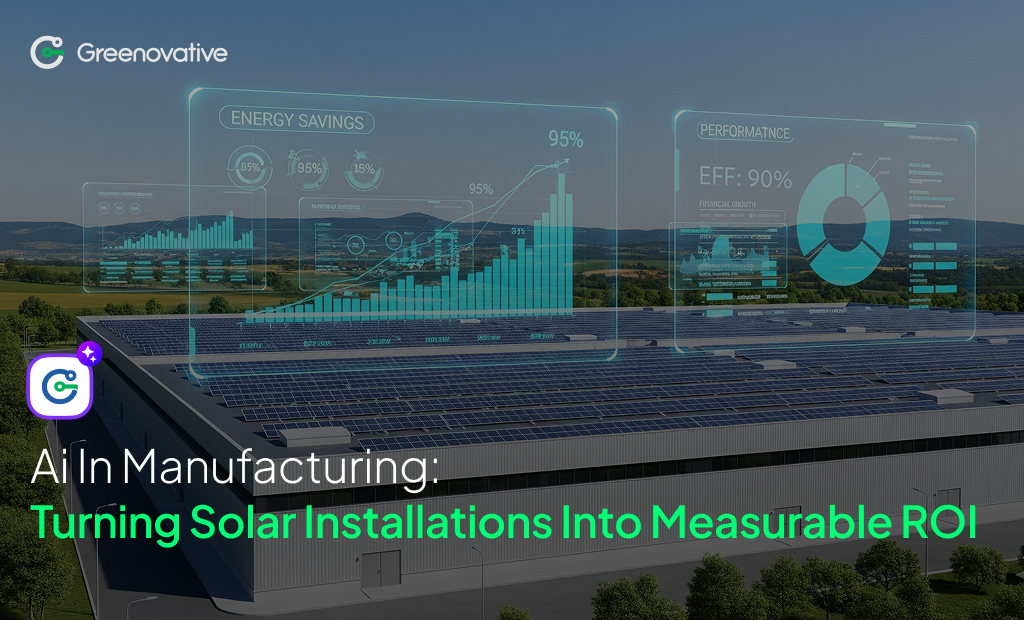
AI In Manufacturing: Turning Solar installations into Measurable ROI

A Manufacturing Shift Powered by Solar

Across industries, manufacturers have turned to solar as a powerful step toward sustainability and savings. “Solar arrays feed generation meters, with dashboards showcasing ‘green energy produced.’”

Every unit of energy consumed or produced carries a direct financial implication. Many manufacturers have already invested in solar to cut costs and reduce carbon footprints. Yet, a crucial question often remains unanswered;

“How do we measure the true financial value of our solar investments?”

This is where Solar AI steps in as the hero, empowering organizations to see beyond just kilowatt-hours and truly connect solar energy generation with measurable business returns.

When Data Stops at Generation

Traditional solar monitoring platforms provide limited insights. They track how much energy your panels generate but fail to tell you:

  • Whether that generation translates into real savings.
  • If performance degradation is silently eroding returns.
  • Where opportunities for expansion, storage, or export optimization exist.

For manufacturing facilities, where margins are tight and energy is a critical cost driver, this gap between generation data and financial reality creates uncertainty. Leaders cannot make informed decisions about costs and earnings with only half the picture.

Bridging Generation & Financial Value with Solar AI

Solar AI transforms raw data into actionable intelligence. By combining advanced solar analytics with financial modelling, it helps manufacturers close the loop between what is generated and what is saved.

Here’s how:

  1. Advanced Solar Analytics for Precision
    “With Greenovative’s advanced solar analytics, manufacturers gain real-time visibility into solar performance. It doesn’t just show ‘energy produced’; it highlights efficiency, tracks how solar offsets grid consumption, identifies anomalies, and prescribes corrective actions for underperforming assets.”
  2. From Energy Data to Financial Impact
    Solar AI directly links generation with cost savings, giving leaders a clear view of their financial impact and realization. Instead of just kilowatt reports, businesses see how much they’ve saved, how fast ROI is being achieved, and what strategies will maximize solar ROI further.
  3. Opportunity for Expansion & Growth
    Manufacturing operations are dynamic. Solar AI identifies opportunities for expansion, whether it’s storage integration, peak load optimization, or energy export strategies. This ensures businesses are always ahead with a data-led energy strategy.
  4. Sustainability with Profitability
    Beyond compliance or sustainability goals, Solar AI makes renewable adoption a revenue-positive decision. By bridging generation & savings, it positions green energy not just as a CSR move but as a financial advantage.

Why It Matters to you

If you’re in an energy-intensive industry. With fluctuating demand, machinery loads, and rising tariffs, every inefficiency directly impacts profitability. Solar AI empowers you to:

  • Detect and correct system inefficiencies early.
  • Align sustainability goals with bottom-line impact.
  • Scale renewable adoption with confidence.

With this shift, manufacturers no longer ask, “How much energy did we generate?” but instead ask, “How much value did we realize?”

The Greenovative Edge

At Greenovative, we believe solar must be more than numbers on a dashboard. Our Solar AI solutions deliver a complete view of energy generation, financial impact, and growth opportunities, tailored for manufacturing industries.

By transforming solar monitoring into a data-led energy strategy, Greenovative helps organizations move from generation data to business intelligence. The result? Smarter investments, maximized savings, and measurable progress toward net-zero goals.

Turning Solar into real value

The future of industry is not just about adopting renewable energy, it’s about making every unit of energy work harder for your business. Solar AI translates sunlight into measurable savings, smarter financial decisions, and long-term growth.

With Greenovative’s advanced solar analytics, organizations gain a clear path to maximize ROI, strengthen sustainability, and achieve a lasting competitive edge.