






Inside the Brain: How Greenovative AI Works at Industrial Scale

Imagine saving 15% on energy and operations just by making a few strategic tweaks; not guesses, but data-backed decisions. Now imagine having an intelligent assistant that not only sees the invisible patterns across thousands of machines but also guides you step-by-step to optimize performance, reduce waste, and unlock efficiency. That’s the power of Greenovative AI.

In today’s fast-moving industrial world, leaders don’t need more data; they need meaningful direction. Greenovative AI Platform was built for exactly that: making complex operations smarter, faster, and more sustainable with deep intelligence.

The world no longer needs more data. It needs smarter ways to make data work.

That’s where the Greenovative AI Platform steps in.

Greenovative AI Platform: Built for Real-World Complexity

The Greenovative AI Platform is not just another tool. It’s a purpose-built intelligence engine created for industrial environments. Trained on over 1000+ TB of real operational data and refined through 2000+ asset KPI signatures, it brings industrial AI to life at global scale.

It doesn’t sit outside your operations. It becomes part of it, adapting to live conditions, integrating with existing systems, and continuously learning to deliver better outcomes.

Contextual Intelligence: Understand, Don’t Just Analyze

Manufacturing isn’t just about machines; it’s about interdependent systems, legacy workflows, and round-the-clock operations. From the control room to shop floor, every process affects the next. But traditional monitoring tools miss this interconnection.

Greenovative AI goes beyond raw data to understand context, how a variation in one system influences multiple downstream outcomes. For example, a minor valve miscalibration may seem insignificant, but when viewed contextually, it may signal larger inefficiencies across power, cooling, or emissions.

That’s why contextual intelligence is not a buzzword for us; it’s the foundation for industrial clarity.

System Integration: Turn Silos into Smart Networks

Industrial ecosystems are often fragmented, legacy systems, isolated tools, and disconnected data sources. Greenovative AI Platform breaks through these silos.

It integrates seamlessly with SCADA, ERP, EMS, IoT frameworks, and more. The result? A unified layer of intelligence that provides real-time visibility, control, and optimization across all levels of operations.

This is what transformation looks like in action.

Prescriptive Analytics: Know What to Do Next

Diagnostics tell you what went wrong. Predictions tell you what might go wrong. But prescriptive analytics tells you what to do about it.

Greenovative AI doesn’t stop at insights, it recommends actions. Whether it’s adjusting operational parameters or alerting teams with specific next steps, it empowers decision-makers to move from guesswork to precision.

This is where data turns into decisions. Fast, confident, and effective.

Driving Impact Where It Matters Most

Industries that adopt Greenovative AI Platform don’t just automate; to drive visible outcomes

They reduce energy usage, cut down emissions, improve asset reliability, and streamline workflows. They shift from reactive firefighting to strategic foresight. And most importantly, they future-proof their operations for the challenges ahead.

Because in a world that changes by the minute, only those who act with intelligence will lead the way.

Greenovative AI Platform isn’t the future.
It’s how the future works.
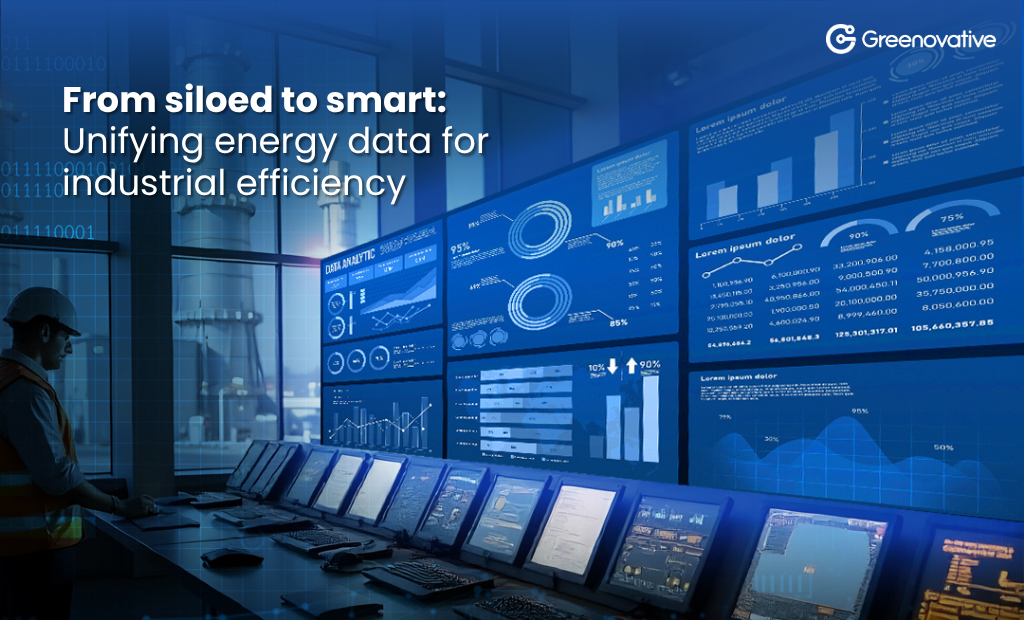
From Siloed to Smart: Unifying Energy Data for Industrial Efficiency

In most manufacturing facilities, data is both abundant and fragmented. Critical information flows in from numerous systems, yet it rarely flows together. On the shop floor, real-time data is captured through SCADA, DCS, MES, and CMMS platforms. Meanwhile, business and finance teams rely on ERP systems, utility billing portals, and cost center reports to track energy spending. At the same time, sustainability teams access emissions monitors and regulatory reporting tools to manage compliance.

Each of these systems serves a vital purpose, but they operate in isolation, creating data silos across departments. The result is a disjointed landscape where teams speak different “data languages,” making it difficult to form a complete, accurate view of energy performance or make coordinated, timely decisions.

Breaking Data Silos in Manufacturing

In the manufacturing industry, a major challenge in effective data management stems from the existence of data silos, isolated pockets of information that remain disconnected across departments. On the shop floor, operational technology (OT) systems like SCADA, DCS, and IoT devices generate vast amounts of valuable real-time data. Meanwhile, business, energy, and sustainability teams often rely on fragmented reports from Excel sheets or ERP systems for performance insights. Because these systems operate in isolation, teams struggle to make sense of the bigger picture when issues arise.

When a sudden energy spike occurs during production, no one can immediately explain why. Was it due to equipment inefficiency, a process anomaly, or an operational oversight? Without a unified view, diagnosing the root cause becomes a daunting task. This fragmented approach to data management is not just inefficient, but costly as well. For modern manufacturers under pressure to cut energy costs, boost productivity, and meet decarbonization goals, the chaos of siloed systems is a major roadblock to progress. Understanding where these silos exist is the first step toward solving the problem.

  1. Operational/Shop Floor Data

This data is generated by systems like SCADA, DCS, MES, and CMMS, which monitor equipment performance, process efficiency, and maintenance. It provides real-time visibility into production but is usually confined to operations teams, making it difficult to share insights with other departments.

  1. Business & Finance Data

ERP systems, BI platforms, utility billing portals, and energy cost reports offer financial visibility across the plant. They help track energy spend and budget allocations but often lack real-time connection with shop floor activities, leading to delayed insights.

  1. Sustainability & Compliance Data

Emissions monitors and ESG reporting tools are used to track environmental impact and meet regulatory requirements. While vital for compliance and corporate reporting, this data often remains disconnected from operational and financial systems, limiting its strategic value.

These systems typically operate independently, with little to no integration. As a result, manufacturers face missed opportunities for optimization, duplicated efforts in reporting, and significant delays in decision-making. Addressing these silos through a centralized data repository is critical for building a smarter, more connected, and future-ready manufacturing ecosystem.

Why a Centralized Energy Data Repository is the Game-Changer for Manufacturing

In today’s data-rich but insight-poor manufacturing environment, a Centralized Energy Data Repository (CEDR) is fast becoming a transformative solution. At its core, a CEDR is a unified digital platform that collects, stores, and organizes energy-related data from various sources, whether it’s from shop-floor sensors, operational technology (OT) systems like SCADA and DCS, or business-level tools like ERPs and spreadsheets. Rather than letting data stay trapped in silos, it brings everything together in real-time, enabling a complete and coherent view of energy consumption across the plant.

Greenovative’s AI-Powered Approach to Smarter Energy Decisions

Modern platforms take this a step further by integrating Artificial Intelligence (AI), making them not just data storage tools but intelligent decision-support systems. AI-backed energy management solutions, like Greenovative’s real-time platform, analyze massive volumes of energy data to uncover hidden inefficiencies, forecast consumption, and even recommend automated control strategies. This platform continuously learns from data patterns and adapts in real-time, optimizing energy use without manual intervention.

By offering centralized visibility, all stakeholders, from facility managers and energy teams to C-suite executives, can access the same set of real-time insights. This connectivity allows for cross-functional collaboration and deeper analysis. For instance, teams can easily correlate energy spikes with unplanned machine downtime or production anomalies, enabling a better understanding of cause-effect relationships that would otherwise be lost in fragmented systems. In high-energy environments like manufacturing, having a centralized energy data repository powered by AI is no longer a ‘nice-to-have, it’s a strategic necessity. It provides the foundation for smarter, data-driven manufacturing operations that are agile, efficient, and aligned with net-zero ambitions.

Contact us or click here to learn more.