





Leadership, Energy, and AI: From Intent to Governed Execution

Most leadership teams are aligned on outcomes: stable margins, predictable costs, operational resilience, and sustained competitiveness. When energy performance falls short of these outcomes, the issue is rarely intent.

It is a translation.

Energy efficiency performance is shaped by thousands of operational decisions made every day across plants, utilities, and shifts such as setpoints, schedules, overrides, sequencing, and responses to deviations. Leaders review energy periodically. These decisions happen continuously.

This creates a structural gap between what leadership expects and what operations deliver.

Why energy belongs in leadership conversations

Energy is no longer just an operating cost. Variability in energy performance directly translates into variability in margins, risk exposure, and competitiveness, outcomes leaders are accountable for.

Yet most organisations still manage energy through dashboards, reports, and periodic reviews. These mechanisms explain outcomes after the fact. They do not shape behaviour while outcomes are being created.

This is not an execution failure.
It is an operating model limitation.

The real mismatch: leadership works through intent, energy through events

Leadership operates through direction: 

  • targets
  • policies
  • guardrails

Energy systems operate through events: 

  • deviations
  • anomalies
  • trade-offs
  • moment-by-moment operational decisions

When intent is reviewed periodically but decisions occur continuously, consistency breaks down. Performance becomes dependent on individuals, experience, and availability, not on a system.

Where AI changes the equation

AI’s real contribution is not better analytics.
It is governance with operational control at scale.

An effective AI layer:

  • detects deviations as they occur
  • adds context on what changed and why it matters
  • prescribes or, where appropriate, automates the next operational action
  • applies the same decision logic across plants and shifts

This ensures leadership intent does not stop at visibility, but translates into action at the point decisions are made.

Energy moves from being monitored to being governed and controlled.

What AI-led energy governance looks like

In practice, governed energy systems exhibit three characteristics:

Consistency
The same situation leads to the same decision, relieving cognitive load on operators and making performance independent of site, shift, or individual.

Event-driven intervention
Actions are triggered by deviations as they occur, not by meetings or retrospective reviews.

Predictable outcomes
The value is not only lower average cost, but lower variability, fewer surprises, and fewer persistent losses.

For energy leadership, this translates to controllability without micromanagement.

Reframing the leadership question

The relevant leadership question is no longer:
“Do we have enough energy data?”

It is:
“Do we have a system that ensures the right decisions happen when conditions change?”


AI becomes the execution layer that translates intent into repeatable behaviour, supporting operators, enforcing guardrails, and keeping performance within defined bounds.

“Leadership does not need to manage energy daily. 
Leadership needs confidence that energy is governed daily. “

When intent is embedded into an AI-driven operating system, energy performance stops depending on individuals and starts behaving like a controlled enterprise function. It becomes aligned with leadership expectations by design, not by exception.
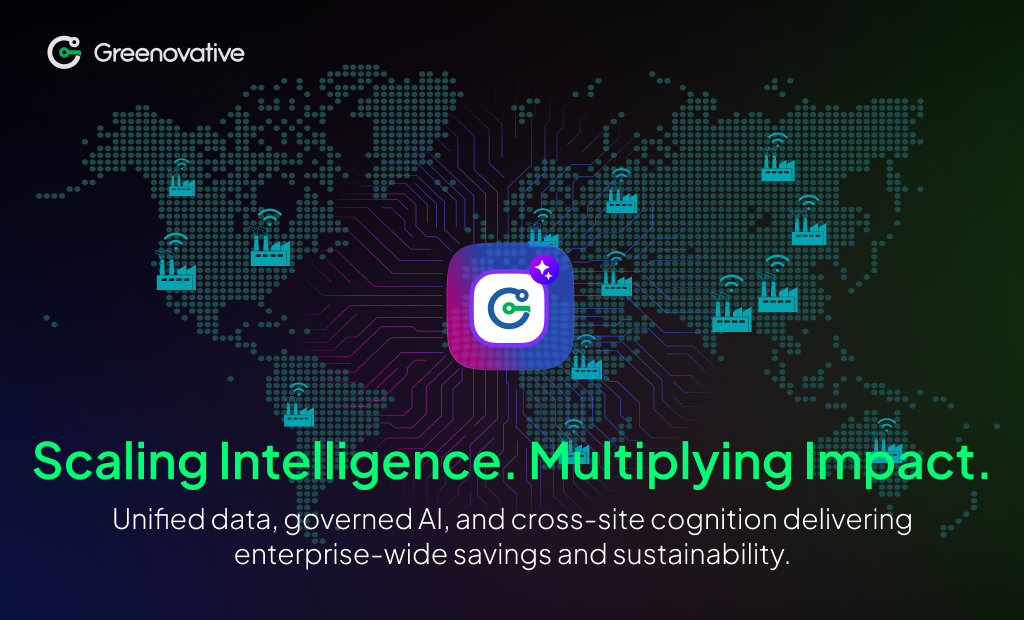

Scaling Industrial AI for Enterprise-Wide Impact

Industrial AI is no longer experimental; it’s becoming an operational necessity. Global studies from Deloitte and BCG estimate that scaling AI in manufacturing can unlock 8–12% cost savings and 10–20% productivity gains. Yet, McKinsey’s 2024 State of AI in Manufacturing notes that fewer than 20% of companies have moved beyond pilot projects. Most remain trapped in localized proofs of concept, showing potential but failing to influence enterprise-level performance.

The Limitation of Pilots

Pilots typically deliver isolated success. One plant might reduce its utility bill or optimize a compressor, but the results rarely extend beyond that site.
Data structures differ, KPIs are defined inconsistently, and decision-making depends on a few experts who “know the system.” Without shared logic or continuity, each site must rediscover what another already learned. The outcome is multiple disconnected experiments, fragmented insights, and limited impact on enterprise profitability or sustainability.

The Missing Link: Building a Horizontal Intelligence Layer

What manufacturers need isn’t more dashboards or localized models. They need a horizontal intelligence layer that connects data and decisions across plants, utilities, and business functions.

This layer ensures that insights discovered in one facility can instantly inform others, creating a single cognitive framework where AI learns collectively and prescribes consistently. It bridges the gap between localized analytics and enterprise-level decision intelligence, making every action explainable, repeatable, and governed under one logic.

Greenovative’s Approach to Enterprise Impact

At Greenovative, we design AI that scales intelligence, not software. Greenovative platform transforms scattered site data into one enterprise operational graph, empowering organizations to manage performance, cost, and carbon holistically.

  • Unified Data Architecture:

    All sites, utilities, and systems feed into a normalized data model that enables unified KPIs and cross-site visibility.

  • Centralized AI Governance:

    Ensures consistent interpretation, transparent logic, and regulatory compliance across global operations.

  • Cross-Functional Intelligence:

    Connects energy, asset, and sustainability layers, turning isolated optimizations into enterprise-wide efficiency.

  • Modular AI Design:

    Each site adapts the core AI to local conditions while enriching the global learning loop, making every deployment smarter.

The result is an enterprise that doesn’t just monitor; it understands, learns, and prescribes actions with measurable business outcomes.

Outcomes of True Enterprise AI

Organizations adopting Greenovative AI report tangible, repeatable value:

  • Cross-Site Benchmarking:

    Standardized metrics reveal which plants lead or lag, enabling targeted interventions.

  • Faster Replication of Best Practices:

    Proven optimizations in one unit can be applied across the network within weeks, not quarters.

  • Unified ROI and Carbon Visibility:

    CXOs gain consolidated oversight of financial savings, energy intensity, and emission reductions across the enterprise.

  • Continuous Improvement at Scale:

    Every plant’s experience strengthens the collective model, creating a self-learning organization.

Across global deployments, Greenovative has enabled over $20 million in verified savings, 470,000 tons of CO₂e reductions, and ROI within 18 months, proof that prescriptive, enterprise-wide AI delivers measurable impact far beyond analytics.

Conclusion: Scaling Intelligence, Not Just Software

Industrial AI maturity isn’t defined by the number of pilots; it’s measured by how consistently an organization converts data into action across every plant and process.
The future belongs to manufacturers that treat intelligence as shared infrastructure, not a local experiment.

Greenovative enables that future by embedding cognition into the enterprise fabric, so every decision, from energy dispatch to carbon strategy, is informed by data, guided by AI, and measured by results.

Achieving Net-Zero with Technology: How AI and Automation Drive Carbon Neutrality

Introduction

As the urgency to address climate change intensifies, the concept of achieving a net-zero emissions has emerged as a critical goal for organizations worldwide. Governments, businesses, and industries alike are striving to align with global sustainability targets and ESG mandates. According to the United Nations Framework Convention on Climate Change (UNFCCC), over 70 countries, including major economies like the U.S. and China, have pledged to achieve net-zero emissions by 2050, underscoring the global commitment to this goal. While the road to net-zero is fraught with challenges, advancements in technology, particularly AI and automation, offer powerful tools to accelerate progress. For leaders, the question is not whether to invest in these technologies but how to leverage them effectively to drive carbon neutrality.
This blog explores the pivotal role AI and automation play in enabling organizations to achieve their net-zero ambitions, highlighting actionable strategies, tangible benefits, and future trends.
The Net-Zero Imperative
Achieving net-zero emissions means balancing the greenhouse gases emitted into the atmosphere with those removed, resulting in a net-zero carbon footprint. The stakes are high:

  • Regulatory Pressure: Governments worldwide are enforcing stricter emissions regulations and carbon taxes, as emphasized in the latest IPCC (Intergovernmental Panel on Climate Change) report.
  • Investor and Consumer Demand: According to a 2023 McKinsey report, over 65% of global consumers prefer sustainable products, while institutional investors are increasing scrutiny on ESG compliance.
  • Operational Costs: Research from the International Energy Agency (IEA) highlights that energy inefficiency contributes to over $2 trillion in avoidable costs annually.

For organizations, the challenge lies in transforming operations while maintaining profitability and efficiency. This is where AI and automation provide game-changing solutions.
How AI and Automation Drive Carbon Neutrality

  1. Energy Optimization and Efficiency
    1. Predictive Energy Management: AI analyzes historical energy usage patterns to predict future demands, enabling precise energy allocation and minimizing wastage.
    2. IoT-Enabled Monitoring: Smart sensors and automation systems monitor real-time energy usage, identifying inefficiencies in HVAC systems, production equipment, and utility processes.
    3. Dynamic Load Balancing: AI dynamically adjusts energy consumption across operations based on renewable energy availability, reducing dependence on non-renewable sources. A report from Deloitte highlights that AI-driven energy management can reduce operational energy costs by up to 15%.
  2. Renewable Energy Integration
    1. Forecasting Renewable Energy Output: AI models predict solar and wind energy availability, allowing organizations to optimize energy storage and usage.
    2. Automation in Energy Transitions: Automation ensures seamless transitions between renewable and non-renewable energy sources, maintaining operational stability.
    3. Virtual Power Plants (VPPs): AI-driven VPPs aggregate energy from distributed renewable sources, enabling organizations to maximize renewable energy contributions. According to BloombergNEF, VPP adoption is expected to grow by 40% globally by 2030.
  3. Carbon Emissions Tracking and Reduction
    1. Real-Time Carbon Monitoring: AI tracks emissions across value chains, providing granular insights into emissions hotspots.
    2. Process Optimization: Automation reduces emissions by streamlining energy-intensive operations such as manufacturing, transportation, and logistics.
    3. Carbon Footprint Modeling: AI tools simulate operational changes to evaluate their impact on emissions reduction, as highlighted in a recent WEF (World Economic Forum) sustainability report.
  4. Supply Chain Decarbonization
    1. Sustainable Sourcing: AI identifies suppliers with low-carbon practices, enabling organizations to build greener supply chains.
    2. Route Optimization: Automation optimizes logistics routes to minimize fuel consumption and emissions during transportation. According to Gartner, AI-enabled logistics can reduce transportation emissions by up to 10%.
    3. Lifecycle Assessments: AI assesses the carbon impact of products throughout their lifecycle, supporting sustainable design and end-of-life strategies.
  5. Waste Management and Circular Economy
    1. Smart Waste Sorting: AI-driven automation identifies recyclable materials, reducing landfill contributions and promoting circular practices.
    2. Resource Optimization: AI ensures efficient use of raw materials, minimizing waste during production.
    3. Closed-Loop Systems: Automation supports closed-loop manufacturing processes, enabling reuse and recycling of materials.

Challenges and Barriers to Adoption
While AI and automation present significant opportunities, organizations must address certain barriers:

  • Data Quality and Availability: Incomplete or inaccurate data can hinder the effectiveness of AI models.
  • Integration with Legacy Systems: Retrofitting existing infrastructure with AI and automation requires investment and expertise.
  • Talent and Skills Gap: Organizations must invest in upskilling teams to manage and deploy these technologies effectively.
  • Cybersecurity Concerns: Increased reliance on connected systems and AI raises the risk of cyber threats, as noted by a PwC report on digital resilience.

The Leadership Imperative
For leaders, achieving net-zero with technology requires a strategic and proactive approach:

  1. Define Clear Net-Zero Goals: Establish measurable sustainability targets and align AI and automation initiatives with these objectives.
  2. Invest in Scalable Infrastructure: Build data pipelines, IoT networks, and cloud platforms to support AI and automation deployment.
  3. Foster Collaboration Across Value Chains: Partner with suppliers, logistics providers, and technology experts to drive end-to-end sustainability.
  4. Measure, Refine, and Scale: Continuously monitor the impact of AI-driven initiatives, refine strategies, and scale successful implementations.

Conclusion: Technology as the Catalyst for Net-Zero
Achieving net-zero emissions is one of the most critical challenges of our time, but it also represents a tremendous opportunity for innovation and growth. AI and automation provide the tools to not only meet sustainability targets but also unlock new levels of operational efficiency and resilience. By embracing these technologies, organizations can position themselves as leaders in the global transition to a low-carbon economy.
According to a recent McKinsey study, organizations that leverage advanced technologies in their sustainability strategies see up to a 25% improvement in their carbon reduction timelines. The journey to net-zero begins with bold leadership, strategic investments, and a commitment to leveraging technology for a sustainable future.
Are you ready to take the first step? Click here to schedule a demo or contact our sales team to learn more.

ESG Data Analytics: How Organizations Can Make Their Sustainability Efforts Measurable

Introduction

As environmental, social, and governance (ESG) criteria become central to business operations, organizations are increasingly required to measure, track, and report their sustainability efforts. Investors, regulators, and consumers demand transparency and accountability, making ESG data analytics a critical tool for organizations to demonstrate their commitment to sustainability. For industries such as manufacturing and energy-intensive operations, ESG data analytics plays an even more significant role in ensuring compliance, optimizing operations, and achieving long-term sustainability goals.

This blog explores how ESG data analytics empowers organizations to quantify their sustainability initiatives, streamline compliance, and enhance decision-making, all while aligning with global sustainability standards.

The Tangible Role of ESG Data Analytics

  1. Tracking Emissions and Resource Usage with Precision
    • Granular Insights: IoT-enabled sensors provide precise, real-time data on energy consumption, emissions, and water usage at equipment, process, and facility levels. For example, a manufacturing plant can monitor its energy consumption per production unit and track how it impacts its carbon footprint.
    • Carbon Accounting: ESG platforms calculate emissions according to frameworks like the Greenhouse Gas (GHG) Protocol, ensuring accuracy in Scope 1, 2, and 3 emissions reporting. Organizations like Siemens have adopted such tools to achieve precise carbon tracking across their operations.
    • Water Usage Optimization: Data analytics tracks water usage trends, helping identify inefficiencies and enabling process adjustments to conserve resources.
  2. Simplifying Compliance and Reporting
    • Automated Reporting: ESG platforms integrate seamlessly with existing energy management systems to automate reporting for compliance frameworks such as ISO 14064 and ISO 50001.
    • Regulatory Alerts: Analytics tools notify teams of deviations from compliance thresholds, allowing immediate corrective actions. For instance, real-time alerts for emissions exceeding allowable limits can prevent regulatory penalties.
    • Audit Readiness: Historical data storage and streamlined visualization ensure organizations can respond to audits with minimal effort while maintaining transparency.
  3. Driving Operational Efficiency Through Benchmarks
    • Facility Comparisons: ESG analytics platforms benchmark energy efficiency across multiple facilities, identifying underperforming plants and processes. For example, a global manufacturer reduced its energy consumption by 15% by benchmarking and replicating best practices from its highest-performing site.
    • Waste Reduction: Data analytics highlights inefficiencies in material usage and waste generation, enabling manufacturers to adopt circular economy principles such as recycling and reuse.
    • Energy Optimization: Predictive analytics optimizes equipment schedules, ensuring that energy is consumed during off-peak hours when costs and emissions are lower.
  4. Enhancing Decision-Making
    • Scenario Simulations: AI-driven models simulate the impact of operational changes, such as adopting renewable energy sources or modifying production processes, to guide decision-making.
    • Proactive Risk Management: ESG analytics identifies risks related to supply chain sustainability, energy pricing volatility, and regulatory shifts, allowing businesses to adapt strategies proactively.
    • Custom KPI Dashboards: Organizations can create tailored ESG key performance indicator (KPI) dashboards to track progress on goals such as emissions reductions, water savings, and energy efficiency.

Case Studies: ESG Data Analytics in Action

  1. Energy Efficiency in Manufacturing: A global electronics manufacturer used ESG data analytics to track energy usage across production lines, achieving a 12% reduction in energy consumption and compliance with ISO 50001 standards.
  2. Supply Chain Transparency: A leading automotive company implemented analytics tools to assess supplier sustainability metrics, ensuring alignment with Scope 3 emissions goals. This initiative reduced its supply chain emissions by 18% over three years.
  3. Carbon Neutrality Progress: A cement manufacturer utilized ESG analytics to simulate the adoption of alternative fuels, reducing its carbon footprint by 20% while maintaining production output.

Challenges to ESG Data Analytics Implementation
While ESG data analytics offers significant benefits, its implementation is not without hurdles:

  • Data Integration: Combining siloed data from legacy systems with modern analytics platforms requires investment and expertise.
  • Accuracy and Consistency: Ensuring high-quality data input is essential for reliable ESG reporting and actionable insights.
  • Cost of Deployment: Advanced ESG analytics systems demand financial resources for deployment, customization, and maintenance.
  • Cross-Functional Collaboration: Aligning stakeholders across operations, compliance, and sustainability teams is critical to successful implementation.

Actionable Steps to Adopt ESG Data Analytics

  1. Define Measurable ESG Goals: Establish clear objectives, such as emissions reduction targets or water conservation goals, and align them with global standards like the Science-Based Targets initiative (SBTi).
  2. Invest in Scalable Technology: Deploy IoT sensors, cloud platforms, and analytics tools to ensure seamless data collection and processing.
  3. Collaborate with Experts: Partner with technology providers and ESG consultants to design tailored solutions that fit your industry and operational needs.
  4. Pilot and Scale: Begin with pilot projects to validate the effectiveness of ESG analytics tools and refine strategies before scaling across the organization.
  5. Monitor Progress Continuously: Use real-time dashboards to track KPIs, address inefficiencies, and ensure compliance with evolving regulations.

Conclusion: Quantifying Sustainability with ESG Analytics
ESG data analytics empowers organizations to move beyond vague sustainability statements by providing tangible, measurable insights into their environmental, social, and governance efforts. By leveraging advanced tools, manufacturers can reduce emissions, optimize resource usage, and ensure compliance with global sustainability standards.

For organizations ready to embrace ESG data analytics, the rewards go beyond compliance. These tools drive operational efficiency, build stakeholder trust, and position companies as leaders in sustainability. Are you prepared to make your sustainability efforts measurable and impactful?

Click here to schedule a demo or contact our sales team to learn more.