






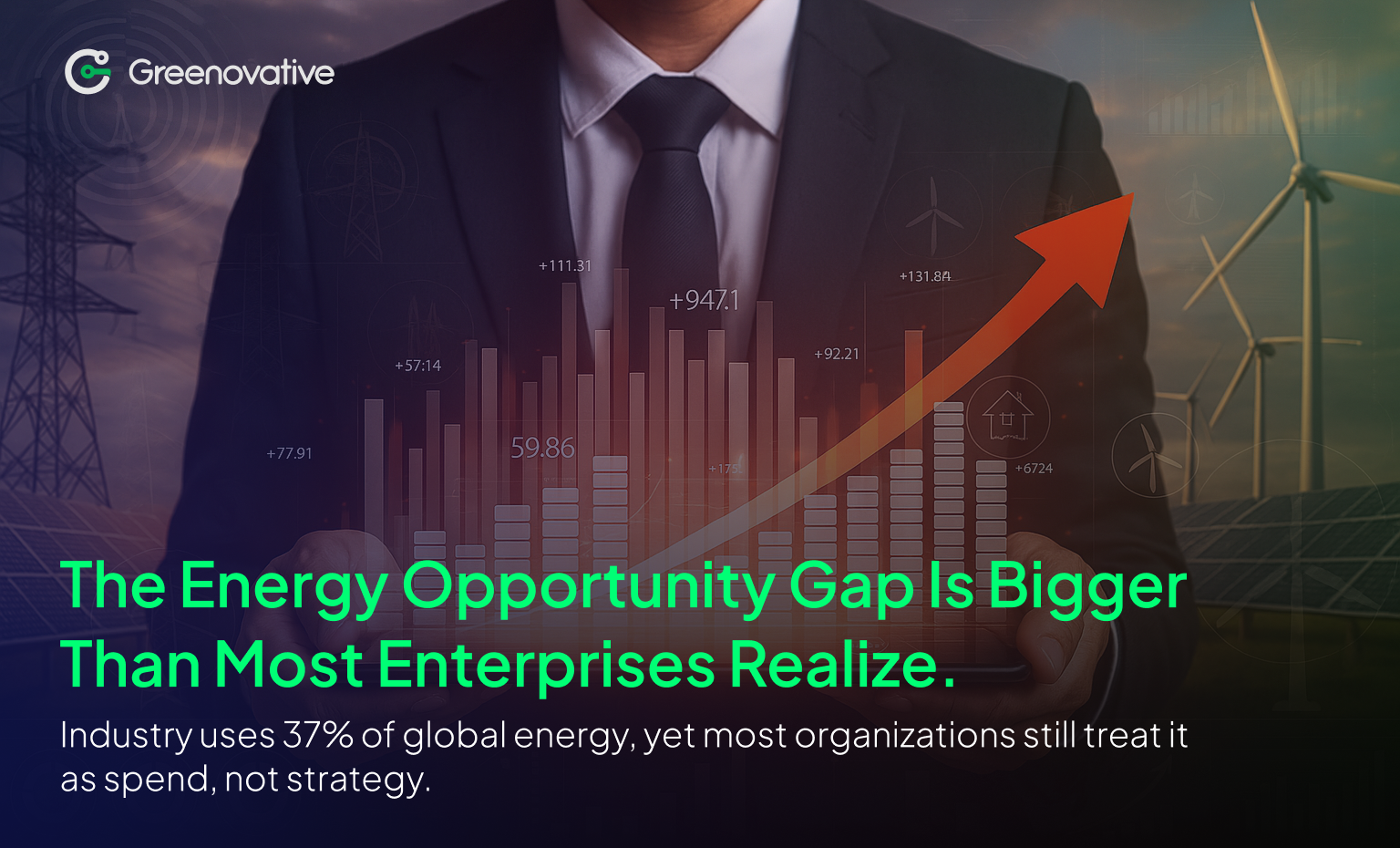
The Energy Opportunity Gap: Why Energy Deserves a Seat in the Boardroom Energy as a Strategic Lever, Not a Utility Bill

Energy is no longer just a resource that fuels machines; it fuels enterprise value.
Every ton produced, every batch completed, and every emission reported has energy at its core.
In manufacturing, energy determines operating margins, cost efficiency, ESG performance, and long-term resilience.

According to the International Energy Agency (IEA), the industrial sector accounts for approximately 37% of global final energy use and around 24% of energy-related CO₂ emissions, highlighting how fundamental energy is to value creation.
It is one of the few variables that simultaneously affects profitability, sustainability, and enterprise value; yet it is still treated as an operational line item.

The reality: the way enterprises manage, optimize, and interpret energy data can define their future competitiveness.

The Value Chain Multiplier

Energy impacts every dimension of enterprise performance across cost, carbon, and competitiveness.

Cost Driver:

25–40% of total manufacturing cost is energy-linked in energy-intensive sectors.
KPMG’s global manufacturing cost competitiveness study clearly identifies utility and energy cost as a primary cost driver influencing margin strength, competitiveness, and location strategy.

Carbon Driver:

Energy sources define emission intensity and ESG ratings, influencing brand and investor perception.

Continuity Driver:

Energy reliability safeguards uptime, delivery commitments, and customer trust.

Together, these drivers determine not only operational success but also how investors value long-term resilience and performance.

The Problem: Energy Still Treated as Expense, Not Asset

Most organizations measure how much energy they consume, not how effectively they use it.
Traditional dashboards show usage trends but fail to connect energy flow with business performance.
Without understanding how energy drives output, cost, and carbon, enterprises underutilize their most powerful lever for value creation.

The result: billions spent globally on monitoring consumption, but little progress in optimizing the economics behind it.
Energy remains managed by operations and finance when it should be governed as a strategic domain at the board level.

The Transition: From Energy Management to Energy Intelligence

To close this gap, organizations must move beyond consumption tracking to energy intelligence, the ability to link energy performance directly to business outcomes.

Greenovative’s platform enables that shift by transforming energy from a cost center into a strategic performance variable:

  • Links energy flow to output, cost, and carbon metrics, mapping how each unit of energy impacts productivity.
  • Unifies plant-level data into enterprise-wide intelligence, offering real-time visibility across assets, shifts, and sites.
  • Quantifies value by showing how improvements in energy efficiency translate into measurable financial and sustainability outcomes.

This approach turns operational data into boardroom insight, helping leadership see where energy efficiency drives margin, carbon reduction, and resilience simultaneously.

Conclusion

Energy is not just what powers operations, it powers enterprise value.
Companies that treat energy as strategy consistently outperform in cost control, ESG scores, and competitiveness.

For CXOs, the question has evolved: it is no longer “How much energy do we use?” but “How much value do we create from the energy we use?”

Greenovative enables that transformation, equipping enterprises with intelligence that connects energy, productivity, and profitability at scale.
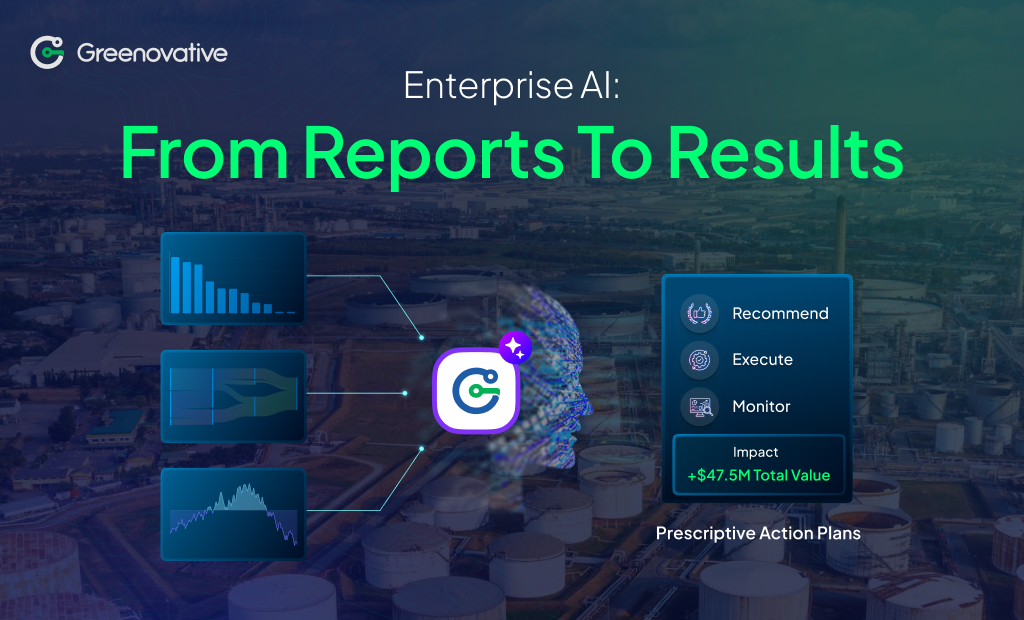
Enterprise AI – From Reports to Results

In many enterprises today, what’s called “AI” is often just dashboards or BI tools with smarter visuals. They tell decision-makers what happened, but rarely why, and almost never prescribe what to do next.

The real leap is from descriptive tools to prescriptive intelligence, an AI that behaves like a strategic advisor, interpreting complexity, recommending high-impact actions, and driving real outcomes.

Why Most “Enterprise AI” Today Is Just Dressed-Up BI

  • Data-rich, insight-poor: According to industry forecasts, the global enterprise AI market is estimated at USD 97.2 billion in 2025, climbing to USD 229.3 billion by 2030 (CAGR ~18.9 %). Yet many adopters remain stuck at dashboards.
  • Descriptive bias: Most systems focus on aggregation, trend-lines, and alerts, showing correlations or past deviations, but not giving causal clarity.
  • Action gap: Even when insights emerge, translating them into executable decisions often remains with human teams, introducing delays, inefficiencies, and guesswork.
  • Siloed intelligence: AI deployments often live within functions (supply chain, maintenance, energy) with little cross-domain decision coordination, limiting strategic coherence.

The gap is clear: dashboards tell, but don’t act. Strategy leaders and CFOs increasingly demand AI that turns data into decisions, not just insights.

What True Enterprise AI Looks Like

The shift is from “reporting AI” to prescriptive, decision-intelligence AI. The key traits:

  1. Interprets Complexity
    Advanced models ingest multiple domain signals (e.g. energy management system, operations, maintenance, market data) simultaneously and decode interdependencies.
  2. Prescribes Clear Actions
    Instead of issuing alerts, the system recommends optimized interventions (e.g. reroute load, change schedule, modulate inputs) with expected metrics (e.g. cost savings, risk reduction).
  3. Simulates & Validates
    It runs “what-if” scenario simulations, quantifies trade-offs, and refines suggestions based on real-world feedback.
  4. Drives Outcomes
    It doesn’t stop at suggestions, monitors execution, verifies results, and adapts continuously.
  5. Acts as Strategic Advisor
    It elevates from an operational tool to a partner in planning: linking decisions to P&L, carbon, risk, and competitive positioning.

One research direction, for example, is PresAIse, a prescriptive AI framework enabling users to interact via natural language, interpret causal inference, and suggest decisions in enterprise contexts.

From Insight to Impact

Consider a manufacturing company that observed repeated supply-chain disruptions. Their “AI” dashboard flagged frequent delays and rising costs, but didn’t propose why or how to fix them.

A real enterprise AI system delved deeper:

  • Mapped order-to-fulfilment times against machine downtime, raw material variances, and logistics patterns.
  • Prescribed an action: shift loading of specific SKUs to alternate lines during weather-forecasted delays.
  • Simulated the projected gain: a 4 % cost reduction and 8 % improvement in on-time delivery.

This is not magic, it’s AI as strategic advisor, turning raw data into executed decisions.

Key Benefits for Strategy & Finance

  • Higher ROI on data assets: You stop investing in dashboards and begin capturing value from them.
  • Shorter decision cycles: From insight to action in hours, not weeks.
  • Risk reduction: Because decisions come with built-in simulations and validation.
  • Scalable decision capacity: Human leaders remain in control, but AI supports high-velocity, multi-parameter trade-offs.
  • Competitive differentiation: Companies that operationalize AI beyond reporting can outperform peers by 5–15 % on margins, agility, and innovation.

Adopting Enterprise AI: Key Considerations

  • Data infrastructure maturity: You need solid pipelines, clean models, and cross-domain integration.
  • Model transparency & interpretability: Business users must understand why the system makes certain suggestions.
  • Responsible AI governance: Decisions must be auditable, traceable, and aligned with regulatory/ethical frameworks.
  • Continuous feedback loop: The system must learn from outcomes to refine prescriptions.

According to Wikipedia’s definition of prescriptive analytics, this stage of analytics “suggests decision options… and shows implications of each decision option,” advancing significantly beyond descriptive and predictive models.

From Reports to Impact

Enterprises that lean on dashboards alone are operating at a plateau. The true frontier of AI lies in prescriptive, decision-intelligence systems, where AI is not a passive tool but an active advisor.

Moving from insight to impact means:

  • recognizing that AI must prescribe, not only report;
  • integrating cross-domain signals;
  • validating recommended actions;
  • and closing the loop on execution and outcomes.

If your current AI feels more like visualization than transformation, it’s time to reframe: AI should not just show you what’s happening, but tell you what to do next, predict what will happen, and ensure the results follow.