







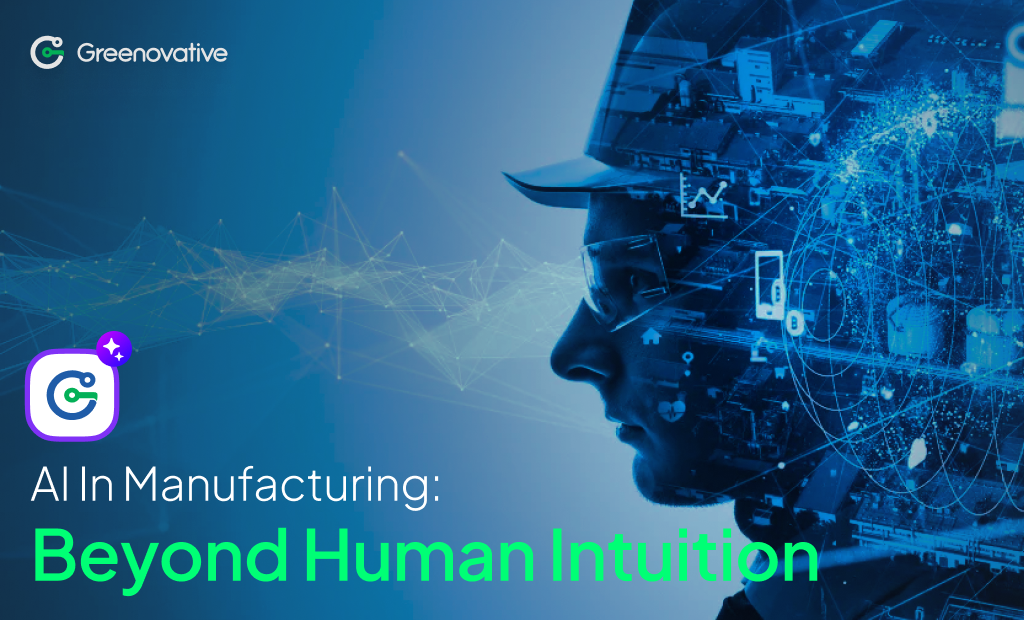
Artificial Intelligence in manufacturing is no longer experimental; it’s mainstream.
According to the World Economic Forum, factories that have adopted AI-driven operations report 10–20% performance improvement and significant energy efficiency gains. Similarly, IBM Research notes that AI-enabled analytics can reduce energy waste and improve decision accuracy across complex production environments.
Yet despite these advances, most industrial decisions still depend heavily on human intuition, experience-based judgment shaped by years on the shop floor.
That experience remains invaluable, but in an era of hyper-connected systems and billions of data points, intuition alone isn’t enough.
The Limits of Human Intuition
Human intuition is powerful, but inherently constrained:
- Limited data bandwidth: Even the best engineers can track a few dozen variables, while a typical plant streams data from thousands of sensors.
- Memory bias: Operators rely on precedent, “this happened last summer”, which may not apply under new production or tariff conditions.
- Blind spots: Subtle issues like baseload drift, reactive power penalties, or hidden emission spikes emerge gradually and across systems, easily escaping manual detection.
- Unquantified outcomes: Intuition suggests what’s wrong but rarely tells how much it costs or which action yields maximum return.
As manufacturing grows more data-dense, these limitations directly translate into cost, carbon, and competitiveness gaps.
How AI Augments Intuition
AI doesn’t replace human judgment, it strengthens it.
- Continuous data scanning – AI processes live feeds from energy meters, SCADA, EMS, and process sensors, identifying abnormal behavior across assets and shifts.
- Contextual pattern recognition – By learning plant-specific baselines, it recognizes deviations long before they show in KPIs or bills.
- Prescriptive guidance – Instead of just flagging anomalies, AI quantifies potential savings and prescribes clear, actionable steps, translating analytics into ROI.
This combination of breadth (data scale) and depth (context) turns reactive decisions into predictive, repeatable improvements.
A Real-World Example
When a plant’s Specific Energy Consumption (SEC) began to rise, engineers assumed it was due to increased production demand.
AI traced the cause elsewhere: idle baseload creep and off-shift equipment runtime. By prescribing optimized scheduling and automated shutdown sequences, the system cut energy costs by 8%, with zero CAPEX.
This is what happens when intuition meets intelligence, AI quantifies what experience suspects.
Why This Matters for CFOs & Strategy Leaders
Every inefficiency uncovered is a direct financial opportunity.
- Cost leverage: An 8% SEC reduction in a high-energy process can translate into substantial P&L gains.
- Risk control: AI visibility minimizes exposure to tariff penalties and emission non-compliance.
- Strategic planning: Data-backed insight helps CFOs evaluate whether efficiency gains or asset investments drive better returns.
- Sustainability ROI: Linking Scope 1 & 2 emissions to production data turns decarbonization from a reporting task into a measurable performance metric.
As the World Economic Forum observes, the “Lighthouse” factories adopting AI across operations demonstrate sustained competitiveness, not just incremental improvement.
From Instinct to Quantified Action
| Traditional Approach | AI-Augmented Approach |
| Experience + observation | Billions of data points + prescriptive insight |
| Alerts without context | Actions with quantified ROI & CO₂ impact |
| Reactive fixes | Predictive, preventive decision-making |
| Siloed visibility | Unified, cross-system intelligence |
Human intuition remains irreplaceable; it provides context, creativity, and understanding of the plant’s pulse.
But AI extends that intuition to a new dimension, continuous, quantified, and cost-linked.
When both work together, every hidden inefficiency becomes a measurable opportunity, and every decision becomes a data-backed advantage.
If rising SEC or unexplained energy spikes still feel like “normal drift,” it’s time to let AI show the numbers behind the intuition.